


 AIR REGULATORS

 ACCESSORIES

What CFM Do Sandblasters Need to Work Right?
You can tell when a sandblaster is starving for air. The stream pulses, the cut slows down, and you find yourself turning the pressure up just to get back to “okay.” That is the expensive way to learn CFM matters more than almost anything else in your blasting setup.
If you are trying to answer “what cfm do sandblasters need,” the real answer is: enough CFM at your working PSI to keep the nozzle fed continuously, plus a safety margin for losses. Once you size it that way, blasting stops being a fight and starts being predictable.
What “CFM” really means for sandblasting
CFM is the volume of air your compressor can deliver. For blasting, the important part is not the big number on the tank sticker - it is the delivered CFM at the PSI you will actually blast at.Most sandblasting work happens around 80-110 PSI at the nozzle, depending on the media, nozzle, and the surface. Compressors do not deliver the same CFM at 40 PSI as they do at 90 PSI, so always look for a rating like “SCFM @ 90 PSI.” If a compressor only advertises displacement (sometimes called “CFM” without pressure), treat that like marketing, not a sizing number.
Two other things affect what your nozzle actually gets:
First is pressure drop. Every restriction steals air: undersized couplers, long hose runs, cheap filters, and regulators that are too small.
Second is duty cycle. A compressor that can technically hit your CFM but has to run flat-out continuously will run hot, build moisture, and wear out faster. Sandblasting is one of the most demanding air tasks you can throw at a shop compressor.
The shortcut answer to what cfm do sandblasters need
Most “it depends” questions can still be narrowed down fast. For sandblasting, you can usually map the CFM requirement to your nozzle size and PSI.As a practical rule, many common blasting setups land in these bands:
A small cabinet blaster with a 3/32 inch nozzle often wants roughly 8-15 CFM at 80-100 PSI.
A step up to a 1/8 inch nozzle commonly needs around 15-25 CFM at similar pressure.
Production-style blasting with a 5/32 inch nozzle is often in the 25-40+ CFM range.
If you are running a 3/16 inch nozzle, you are usually talking 45-60+ CFM, and that is where tow-behind or rotary screw compressors start to make sense.
Those are not lab numbers, but they are good enough to keep you from buying a compressor that will struggle from day one.
Why nozzle size and PSI drive CFM
Your nozzle is basically an air-sized metering hole. Bigger hole means more air flow. Higher PSI means the air is pushed through harder and you get more flow, too.That is why swapping from a worn nozzle to a new one can change performance. A nozzle that wears even a little larger can jump your air demand, and suddenly a setup that used to hold pressure starts dipping under load.
It is also why “just bump the pressure” can backfire. More pressure can improve cutting, but it can also push your air demand past what the compressor can deliver. When that happens, nozzle pressure falls anyway and your blast pattern gets inconsistent.
A more accurate way to size your compressor
If you want a setup that feels professional, size with a margin.Start with the nozzle’s stated air consumption at your target PSI (many nozzle charts and blaster manuals list this). Then add at least 20-30% to cover real-world losses, moisture equipment, and the fact that you will not always be blasting with a perfectly short hose and perfectly clean filter.
Here is what that looks like in real shop terms:
If your nozzle consumes 18 CFM at 100 PSI, aim for 22-25 CFM delivered at 90-100 PSI.
If your nozzle consumes 30 CFM, aim for closer to 36-40 CFM.
This extra capacity is not waste. It is what keeps pressure stable when the compressor is hot, the filter has some load on it, or you add a longer hose to reach the job.
Cabinet blasters vs pressure pots: different feel, same air math
Cabinet sandblasters often “feel” easier on air because they are used for smaller parts and can run smaller nozzles. But the cabinet itself does not reduce air demand - the nozzle does. A cabinet with a 1/8 inch nozzle still needs the same air as any other 1/8 inch nozzle.Pressure pot blasters tend to run bigger nozzles, longer hoses, and more aggressive media flow. That is where people get surprised. The pot is affordable, the media is easy to buy, and then the compressor becomes the limiting factor.
If you want outdoor blasting to be efficient, plan your compressor around the nozzle you actually want to use, not the smallest nozzle you could tolerate.
The hidden CFM killers in a “good on paper” setup
A compressor can meet the CFM spec and still blast poorly if the air path is choked.Hose diameter is a big one. A long 1/4 inch hose feeding a blaster is a pressure drop machine. For many blasting setups, 3/8 inch is a better baseline, and high-demand nozzles often do better with 1/2 inch air supply. The goal is simple: keep the compressor’s airflow from being throttled before it reaches the blaster.
Couplers and fittings matter, too. Standard quick-connects can be restrictive. If you are trying to feed 25-40 CFM, you want high-flow fittings sized to match the hose, not a tiny bottleneck at every connection.
Moisture control can also “cost” airflow. Filters, separators, and dryers are necessary because wet media clumps and causes surging, but they also add restriction. Buy moisture control components that are rated for the flow you are actually using.
Picking PSI: more is not always better
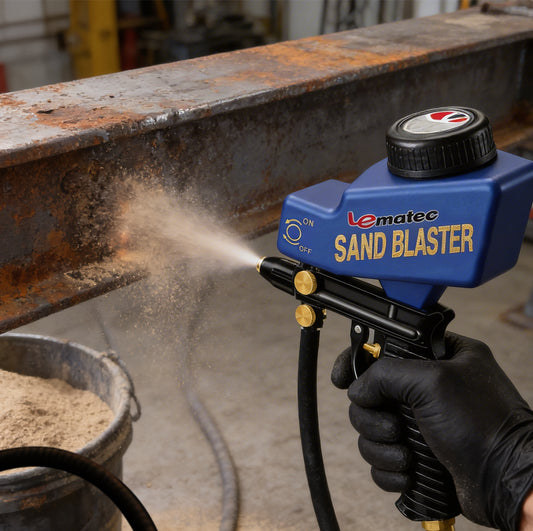
A lot of users default to 110-120 PSI because the compressor can make it. The better approach is to pick a pressure that gives you the finish you want without creating unnecessary air demand, media breakdown, or surface damage.For paint and rust removal on steel, 80-100 PSI is common.
For delicate substrates or thin panels, lower pressure with the right media can prevent warping and reduce heat.
For heavy scale, you may want more pressure, but the payoff only shows up if the compressor can hold that pressure continuously. If your compressor drops from 110 down to 85 while blasting, you are not really blasting at 110.
When a bigger tank won’t fix it
Tank size helps with short bursts. Sandblasting is not a short-burst job. If your compressor cannot produce the CFM, a bigger tank only delays the moment your pressure drops.What actually fixes “runs great for 30 seconds, then dies” is more delivered airflow, not more stored air. That usually means a larger compressor pump, a two-stage unit, or stepping up to a rotary screw compressor for steady high-CFM work.
Real-world compressor matching examples
If you are doing occasional cabinet blasting with a 3/32 inch nozzle, you can often get acceptable results with a solid shop compressor that delivers around 10-15 SCFM at 90 PSI, assuming your hose and fittings are not restricting flow.If you want a cabinet to feel fast and consistent with a 1/8 inch nozzle, plan around 18-25 SCFM at 90 PSI so the compressor is not at its limit the entire time.
If you are running a pressure pot with a 5/32 inch nozzle for frames, wheels, or structural steel, you are in the 30-40+ SCFM neighborhood, and that is where many homeowner-grade compressors tap out.
If you are thinking about a 3/16 inch nozzle because you want real production speed, be honest about what that implies: you are typically in the 50+ SCFM class, with air treatment and plumbing to match.
Don’t forget the rest of the air system
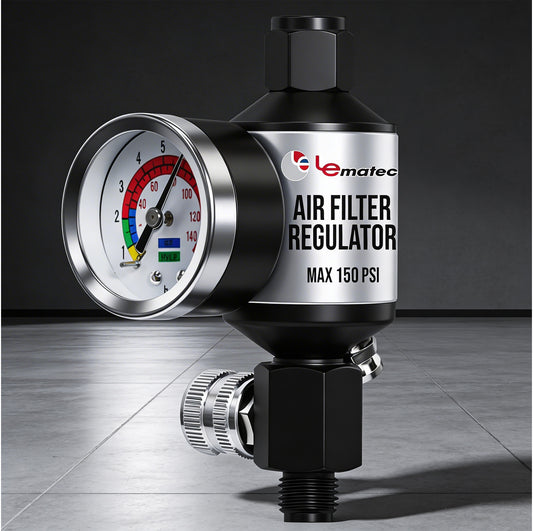
Blasting performance is the whole chain.Use an air regulator that is rated for your flow, not just your pressure.
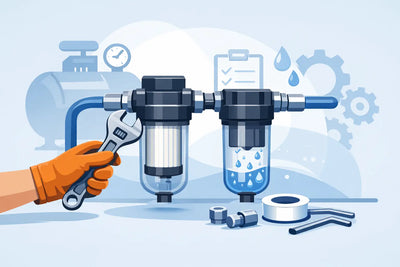
Plan on a filter/water separator close to the blaster, plus a main moisture solution upstream if you blast often. Moisture problems show up as clogging and inconsistent media feed, which feels like “not enough CFM” even when the compressor is fine.
Keep the air line as straight and short as the job allows. If you need distance, step up hose diameter.
Use the right media for the job. Oversized media for a small nozzle can restrict flow and make the system surge. Too fine a media can create dust and reduce visibility, making you think you need more pressure than you do.
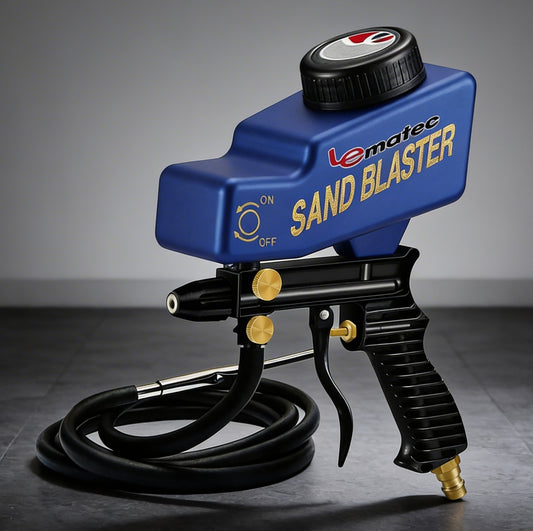
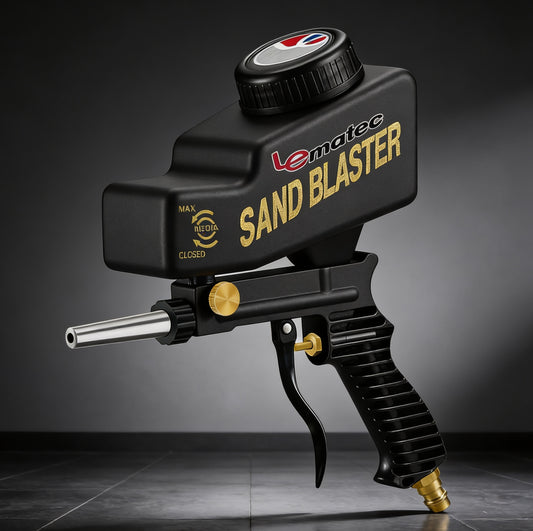
If you want to keep the buying process simple, Pro Air Tools stocks sandblasting gear, media, and the regulators and filters that keep air delivery steady, plus the kind of warranty and fast ship times that matter when your project is waiting.
A quick way to sanity-check your setup
If you are not sure whether you are short on CFM, watch the pressure while blasting. Set your regulator to your target PSI, start blasting continuously, and see what happens.If the pressure holds steady and the blast stream stays consistent, you are likely in the right range.
If the pressure starts high and then steadily falls, you are out of compressor.
If pressure stays up but the stream surges, you may have moisture, media flow issues, or restrictions at couplers, hose, or filters.
That test is worth doing before you buy a bigger compressor, because it tells you whether the problem is airflow capacity or airflow delivery.
Closing thought
Blasting is one of those jobs where the air system either feels effortless or it feels like constant troubleshooting. Get the nozzle size you want, match it with enough delivered CFM at your real blasting PSI, and build in a margin - that is what turns sandblasting from a slow chore into a tool you can count on whenever the job shows up.🛒 Shop Sandblasters
Factory direct from Le Lematec — professional quality, competitive prices.
Related: Learn how to get the cleanest, most consistent air supply for your tools with our filter and regulator setup guide.
Frequently Asked Questions
What CFM do I need for my sandblaster nozzle size?
CFM requirements depend on your nozzle size and operating PSI. A 3/32" nozzle typically needs 8-15 CFM at 80-100 PSI, while a 1/8" nozzle requires 15-25 CFM. For larger 5/32" nozzles used in production, you're looking at 25-40+ CFM. Always add 20-30% margin to account for real-world losses through hose, filters, and fittings.
How do I know if my compressor has enough CFM for sandblasting?
Watch your regulator pressure while blasting. If pressure holds steady and the blast stream stays consistent, your CFM is adequate. If pressure drops continuously while blasting, you're exceeding your compressor's output. If pressure stays up but the stream surges, check for moisture, media flow issues, or restrictions in couplers and filters.
Does a bigger air tank solve CFM problems?
A larger tank only delays pressure drops—it doesn't increase delivered CFM. Sandblasting is continuous-duty work, not short bursts. If your compressor cannot produce sufficient CFM, you need more pump displacement, a two-stage unit, or a rotary screw compressor. Tank size helps with short tasks but won't fix sustained CFM shortages.
Shop Related Products
All products ship free to the US with same-day processing.
Tags:
Previous
Best Air Regulator for a Compressor: Buy Right
Next
Quick Connects for Air Tools: Pick the Right Fit
Related articles
Choosing Air Hose for Shop Layout
Jun 01 2026

How to Set Air Regulator Pressure Right
May 30 2026
Air Filter Water Separator Installation Tips
May 28 2026
Guide to Shop Air Line Layout That Works
May 26 2026
Air Ratchet vs Electric Ratchet
May 24 2026
Media Blasting for Powder Coat Removal
May 22 2026