Shopping Cart
(0)
Free shipping included — no minimum on any US order

Quick Search:


You know the bolt: buried behind an intake runner, tucked under a dash bracket, or hiding in that little pocket between a frame rail and a header tube. You can get a wrench on it, but you cannot swing it. You can get a socket on it, but your knuckles are about to pay the price. This is where an air ratchet earns its keep - not by being the strongest tool in the drawer, but by doing real work where everything else stalls out.
An air ratchet for tight spaces is about geometry as much as power. The best ones aren’t simply “small.” They’re shaped to get the head where it needs to be, keep your hand out of the pinch point, and spin fast enough that you stop wasting time on 20-thread fasteners.
Head size is the make-or-break detail. A compact head gets the anvil and socket closer to the fastener without your hand needing a wide arc. In engine bays and interior work, the difference between “fits” and “doesn’t” can be a few millimeters of head diameter or a slightly shorter nose.
Length matters too, just in a different way. Short bodies are easier between components, but a longer handle can help you reach down into a pocket while keeping your wrist aligned. You’re trading reach for maneuverability. If you do a lot of under-dash and interior bracket work, shorter often wins. If you live in engine bays and suspension pockets, a bit of length can be the difference between a clean approach and a frustrating angle.
Then there’s speed and trigger control. Tight spaces usually come with fragile neighbors - wiring, plastic connectors, vacuum lines, brake lines, aluminum threads. A tool that spins smoothly with a controllable trigger is often more valuable than one that claims high torque but feels like an on/off switch.
A 1/4-inch air ratchet is the “fits anywhere” option. Smaller sockets, smaller head profile, less chance of smashing into something nearby. It’s ideal for smaller fasteners, interior work, hose clamps with hex heads, light brackets, and jobs where you mainly need speed.
A 3/8-inch air ratchet is the daily driver for automotive and maintenance work. It can run the sockets you already use for a lot of underhood and chassis fasteners, and it’s more forgiving when the fastener is a little stubborn. If you’re only buying one, 3/8-inch is usually the practical pick - as long as the head design is compact enough for the spots you work in.
Here’s the reality: if you routinely work in truly cramped areas (dash supports, HVAC housings, tight engine packaging), you’ll feel the difference with a 1/4-inch. If you’re mostly doing accessory brackets, valve covers, and medium fasteners, 3/8-inch tends to cover more jobs without stepping down.
For tight spaces, torque is mostly about getting the fastener started moving, not about doing final breakaway on rusted hardware. If you’re working on older vehicles, exhaust hardware, suspension bolts, or anything corroded, plan on cracking it loose by hand first (or with an impact, if you have room) and then letting the air ratchet do the spinning.
Overbuying torque can backfire in cramped areas. Higher-torque ratchets can be harder to modulate and can snap smaller fasteners if you’re not paying attention. If you frequently deal with 6 mm and 8 mm bolts in aluminum, control beats brute force.
A good workflow is simple: break the fastener loose manually, run it out with the air ratchet, then finish by hand on reinstall. The air ratchet is there to eliminate repetitive wrist work, not replace your judgment.
Air ratchets like consistent airflow. If the tool feels strong for a second and then fades, look at the full path: compressor output, regulator setting, hose size, couplers, and any restrictions. Small hoses and restrictive fittings are common culprits, especially when people run a long 1/4-inch hose and expect the tool to behave like it’s on a short 3/8-inch line.
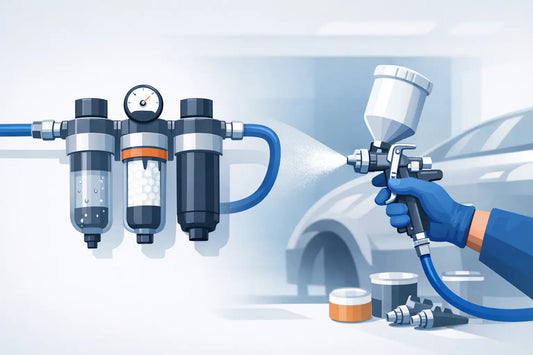
Moisture and dirty air also show up fast in ratchets because they’re precision tools with moving vanes and tight clearances. If your shop air isn’t filtered and regulated, you’re asking for sticky performance and early wear.
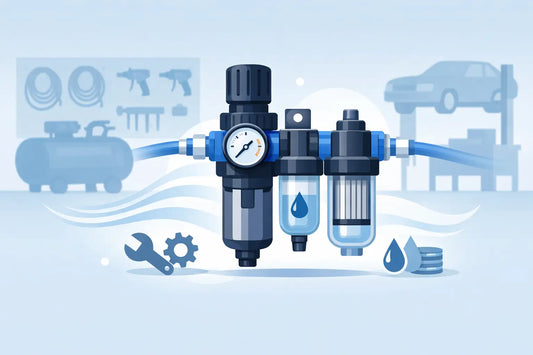
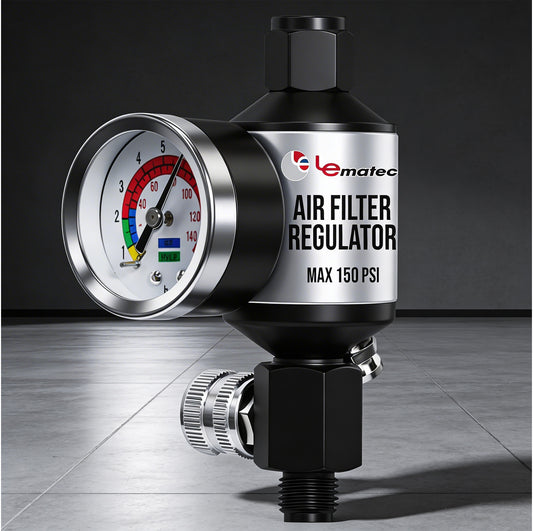
If you’re building a setup specifically for air tools, a basic filter/regulator near the work area is one of the highest-return purchases you can make. It keeps the tool consistent, and consistency is what makes tight-space work feel controlled instead of chaotic.
A compact, low-profile head is the big one. That’s the whole point of buying an air ratchet for tight spaces.
A forward/reverse selector you can hit without repositioning your hand is next. In real-world work you’re constantly swapping direction - run the bolt out, reposition the bracket, run it back in a few threads, back it out again. If you have to pull the tool out every time to flip direction, the “time savings” disappears.
Exhaust direction also matters. If the tool blasts air into your face while you’re wedged under a dash, you’ll notice quickly. A design that routes exhaust away from you is not a luxury in tight quarters.
Finally, pay attention to grip and trigger shape. In awkward angles, your hand isn’t always straight behind the tool. A comfortable grip and predictable trigger make it easier to feather speed, which reduces cross-threading and stops you from over-running fasteners into delicate surfaces.
Start fasteners by hand whenever the threads matter. If you can’t start it by hand, at least thread it a couple turns manually with the socket and extension before you pull the trigger. This is especially important on aluminum parts, small studs, and anything that feels “mushy.”
Once it’s started, use short bursts instead of holding the trigger down. You’re not racing the clock - you’re preventing cross-threading and keeping control in a spot where you can’t see the thread engagement.
For removals, crack the fastener loose first. If the bolt doesn’t want to move, forcing it with the ratchet can stall the tool and wear it out, or it can round the fastener if you’re at an angle. A breaker bar, a flex head ratchet, or a quick hit from an impact (if you have access) sets the air ratchet up to do what it does best.
Engine bay accessory work is where 3/8-inch drive becomes hard to beat. Alternator brackets, tensioner bolts, power steering brackets, and general underhood hardware often live in that middle range where you want the socket variety and a little more muscle. The right head shape still matters, especially around modern packaging.
For cramped chassis pockets, reach can be as important as head size. A slightly longer body can let you approach the fastener without turning your wrist into a pretzel. If you’ve ever tried to run a bolt next to a frame rail with your forearm jammed against the tire, you know what that means.
Look for a ratchet that’s honest about head profile and overall length, not just drive size and max torque. If the listing doesn’t make it easy to understand the tool’s shape, you’re guessing.
Also consider your support and downtime risk. Pneumatic tools are work tools, and when a tool fails, your job stalls. Buying from a supplier that backs the tool and ships fast isn’t just convenient - it’s how you keep a project from dragging out.
If you want a straightforward place to shop air ratchets and the rest of the pneumatic setup that keeps them running right, Pro Air Tools focuses on job-ready air tools with fast fulfillment and a 36-month warranty, which takes some of the risk out of ordering sight-unseen.
Next time you’re staring at a bolt you can touch but can’t swing on, think less about “more torque” and more about “less hassle.” Pick the ratchet that fits the space, set up your air so it stays consistent, and let the tool do the boring part while you stay focused on getting the job done right.
Factory direct from Le Lematec — professional quality, competitive prices.




 AIR REGULATORS

 ACCESSORIES