Shopping Cart
(0)
Free shipping included — no minimum on any US order

Quick Search:


If you have ever leaned your full body weight on a breaker bar and still watched a lug nut laugh back at you, you already know why impact wrenches exist. The real question is why some air impacts rip wheels off in seconds while others stall, hammer forever, and leave you reaching for the cheater pipe anyway.
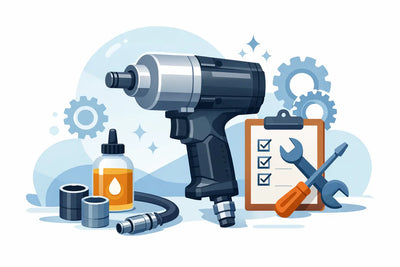
A pneumatic impact wrench for lug nuts can be the fastest, most predictable setup in a home garage or a small shop - but only if the tool, the compressor, and your sockets are working as a system. Get the match right and you stop fighting wheels. Get it wrong and you burn time, air, and patience.
For most passenger vehicles, lug nuts are typically tightened somewhere around 80-110 ft-lb. That sounds modest until you factor in impact of rust, thread friction, and shops that send them home at “whatever the gun was set to.” Real-world breakaway can easily be several times the install torque.
So when you shop for a pneumatic impact wrench for lug nuts, you are not buying for the spec on the service manual. You are buying for the worst lug nut you will meet on a random Tuesday.
Working torque (sometimes “maximum torque”) is more about sustained output once the fastener is already moving. For wheel work, breakaway is what gets you out of trouble. Working torque is what makes the job fast.
Here is the trade-off: bigger torque usually means a bigger, heavier tool and more air demand. If you are doing tires all day, weight and vibration start to matter. If you are a DIYer who wants to stop fighting seized lug nuts twice a year, you might accept extra weight for extra authority.
3/8-inch drive impacts can remove lug nuts on many cars, especially if the fasteners are clean and properly torqued. But they are easier to stall on neglected wheels, and they are more likely to push you into longer hammer time (which is not great for the tool, the socket, or your patience).
3/4-inch drive is for heavy trucks, fleets, and equipment. If you are working on 2500/3500 trucks, RV chassis, or rust-belt commercial stuff, stepping up can save you serious time. The downside is obvious: higher cost, heavier tool, and a compressor that has to keep up.
If your target use case is “lug nuts, brakes, and general suspension work,” 1/2-inch drive is usually the right call.
Two specs matter most: CFM at 90 PSI and your ability to maintain pressure while the tool is hammering. Many impacts want roughly 4-8 CFM for typical use, and higher-output models can want more. If your compressor cannot supply it, the tool will still spin, but the hits get softer and softer until you are basically using a noisy ratchet.
Tank size helps with short bursts. A smaller compressor can sometimes run an impact effectively for quick lug nut removal because the tank acts like a buffer. But if you are doing four wheels, then rotating tires, then doing brakes, you will feel the compressor fall behind. The waiting is what kills productivity.
If you want consistent lug nut performance, set yourself up with a compressor that can hold near 90 PSI at the tool while it is working, not just when it is sitting there idling.
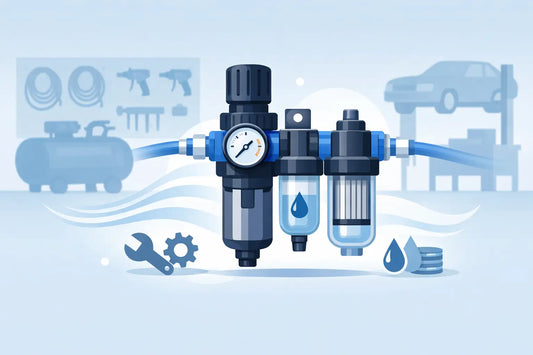
A long 1/4-inch hose, a couple of tight bends, a cheap coupler, and a clogged filter can turn a strong gun into a weak one. For wheel work, many techs prefer a 3/8-inch ID hose if the distance and airflow demands justify it. Shorter is generally better, and high-flow couplers can make a noticeable difference.
This is also where maintenance matters. Water in the line, dirty filters, and sticky regulators do not always show up as obvious problems - they just show up as “this gun used to hit harder.”
Use impact-rated sockets. If you care about your wheels, use protective wheel sockets designed to reduce marring on painted or coated rims. Also pay attention to socket depth. Some lug nuts need deep sockets, and forcing a shallow socket can round corners or damage caps.
A small nuance: if you are trying to break loose a stubborn lug nut, a slightly heavier socket can sometimes help by adding rotating mass that keeps the hammering more effective. It will not fix a bad air setup, but it can help at the margins.
Start by making sure the socket is fully seated and straight. If you are dealing with corrosion, a little penetrant and a minute of patience can save you hardware.
Then use short trigger bursts instead of a long continuous hammer. You are trying to shock the threads loose, not heat-soak the fastener with endless impacts. If it does not move after a few bursts, stop and reassess: better air delivery, a different gun, or hand tools with a breaker bar might be the smarter move than risking a snapped stud.
Once the lug nut breaks free, spin it off. If your impact has a power setting, you can drop power once the wheel is loose to reduce unnecessary hammering.
The clean way to do it is to start threads by hand to avoid cross-threading, snug them in a star pattern, and then finish with a torque wrench to the vehicle spec. This is the difference between “wheel service” and “comeback prevention.” It also protects brake rotors from warping due to uneven clamping.
If you insist on using the impact for final tightening, at least use torque-limiting sticks matched to the spec and still verify with a torque wrench. On modern vehicles with aluminum wheels and sensitive studs, verification is cheap insurance.
Prioritize a realistic breakaway torque rating, a 1/2-inch drive for general wheel work, and an air demand your compressor can actually feed. Then look at ergonomics: trigger control, forward/reverse access, and how the tool feels after a full set of wheels. Noise and vibration also matter more than you think if you do this weekly.
Finally, consider support and downtime. An impact wrench is a work tool. If it fails, your job stops. Buying from a supplier that backs the tool with a real warranty and ships fast is not a nice-to-have - it is part of keeping your shop moving. If you want a straightforward place to source air impacts, hoses, and the small stuff that makes them perform, Pro Air Tools at https://proairtools.com/ is set up for exactly that, with factory-direct pricing, fast shipping, and a 36-month warranty.
But it depends. If you are mobile, working in a parking lot, or do not have a compressor that can keep up, a quality cordless impact may be the better match. Cordless has come a long way, and not having to manage hoses is a real productivity gain in certain environments.
On the other hand, if you have a good compressor and you want a tool you can run for years with basic maintenance, pneumatic still offers a very practical value. The cost per job stays low, and when you size the air system correctly, lug nuts stop being a struggle.
The best setup is the one that makes wheel work boring: the gun hits hard, the nuts come off, and you finish by torquing them correctly without drama. If you build for that outcome - tool, air delivery, and habits - you will feel it every time a stuck lug nut tries to ruin your day and fails.
Factory direct from Le Lematec — professional quality, competitive prices.


 AIR REGULATORS

 ACCESSORIES