Shopping Cart
(0)
Free shipping included — no minimum on any US order

Quick Search:


A basic blow gun can clear a bench. The right attachment can clear metal chips from a blind hole, dry a wet engine bay, inflate a pool tire, or clean a radiator without forcing you to put your hand near moving parts. That is why the best air blow gun attachments are not one-size-fits-all accessories. They are matched to the work, the compressor, and the space you need to reach.
For shop owners, mechanics, fabricators, and serious DIY users, the goal is simple: move air where it helps, without wasting air or damaging the part in front of you. Start with the jobs you do most often, then choose attachments that improve reach, control, and safety.
A useful attachment does more than screw onto the end of a blow gun. It should deliver the air pattern you need at a pressure your compressor can sustain. A tiny opening may feel powerful, but it can drain a small tank quickly and can scatter debris across the shop. A wider, lower-force nozzle may clean more effectively on delicate surfaces because it spreads the airflow instead of concentrating it in one spot.
Fit matters just as much. Many blow guns use standard threaded nozzles, but thread sizes and connector styles are not universal. Confirm that an attachment fits your specific blow gun before ordering. Also check the air inlet connection and the coupler type already used in your shop. Keeping fittings consistent saves time every time you change tools.
Material is another practical difference. Brass threads resist corrosion and are less likely to seize. Steel handles hard shop use, while rubber-tipped nozzles protect painted, machined, and plastic surfaces. For routine cleaning, a durable metal nozzle is usually the right choice. For finish work, rubber contact points are worth having on hand.
A safety nozzle is the best starting point for general shop use. These nozzles are designed to relieve pressure if the tip is blocked, reducing the risk created by dead-ending compressed air against a surface. They are a smart choice for blowing off benches, workholding fixtures, floor mats, and parts after drilling or grinding.
They also help keep airflow more controlled than an open pipe-style tip. That matters when you are clearing chips from a vise or fixture and do not want them launched across the room. Use lower pressure first, then increase only as needed.
For workplace cleaning, follow applicable safety requirements. Compressed air should not be used to clean clothing or skin, and eye protection is not optional when chips, rust, abrasive media, or debris are involved.
A rubber-tip nozzle earns its place around paint, polished metal, glass, trim pieces, and machined surfaces. The soft tip lets you rest the nozzle against a surface or opening without leaving a mark. It is especially useful when drying detail work, clearing coolant passages, or blowing dust from a freshly prepped panel.
The trade-off is that rubber can wear, split, or pick up shop grime over time. Inspect it before using it on a finish-sensitive job. A damaged rubber tip can trap grit and do more harm than a standard metal nozzle held at a safe distance.
Long-reach extensions solve a problem every mechanic and fabricator knows well: the dirt is always behind something. An extended nozzle can reach into frame rails, behind brackets, between radiator fins, inside wheel openings, and into machinery housings without forcing you to disassemble more than necessary.
Choose the extension length carefully. Longer is not always better. A very long tube can flex, reduce control, and become awkward in a crowded engine bay. For most work, a moderate extension is more useful than an extra-long one because it reaches confined areas while still letting you aim precisely.
Use a straight extension when you have a direct path to the target. For areas around hoses, brackets, or suspension components, an angled extension is usually faster.
Angled nozzles direct air around corners, which makes them useful for brake assemblies, transmission housings, machinery guards, and cabinet corners. They are also handy when your hand cannot line up with the area that needs cleaning.
Flexible extensions take this a step further. They can snake into awkward spaces, but they are not the best choice for every task. Flexibility costs precision, and a flexible tube can move under airflow. Use one for light debris or drying work in confined spaces, not for forceful cleaning where exact aim matters.
When the job is broad cleanup, high-volume nozzles move more air across a larger area. They work well for drying washed equipment, clearing dust from a workbench, blowing loose debris from floor mats, or moving lightweight material off large parts.
Venturi-style designs draw in surrounding air to increase the total airflow moved. The result is a wider cleaning effect without simply forcing more compressor air through a tiny opening. This can be useful in shops where cleanup takes time and the compressor needs a break between cycles.
The limitation is control. These nozzles are not ideal for a small drilled passage, a delicate electrical connector, or a concentrated patch of grinding debris. Keep one for broad work and a narrower nozzle for detail work.
Blow guns are commonly used with inflation accessories, but the attachment needs to match the item being inflated. A tapered rubber tip works for toys, air mattresses, and some inflatables. A ball needle handles sports equipment. Tire work calls for a proper tire chuck or inflator with a gauge, not a general-purpose blow gun nozzle.
This is one area where using the right tool prevents avoidable mistakes. A blow gun has no reliable way to show tire pressure, and it can add air faster than expected. For vehicle tires, use a dedicated inflator so you can set and verify pressure accurately.
Before buying attachments, look at four practical factors:
If a blow gun feels weak, the nozzle may not be the problem. Water in the line, a clogged filter, undersized hose, restrictive fittings, or a pressure regulator set too low can all reduce performance. A clean, dry air supply matters most when blowing out sensitive parts or drying surfaces before paint and assembly.
Hose size affects real-world airflow as well. A short, larger-diameter hose generally delivers air more freely than a long, narrow hose with multiple quick-connect fittings. That does not mean every blow gun needs the biggest hose in the shop. It means the attachment, hose, coupler, and compressor should work as a system.
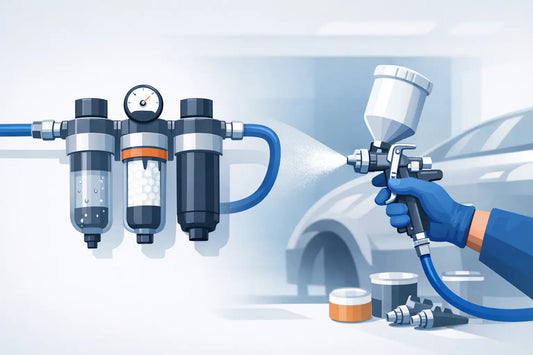
If you regularly switch between impact tools, sanders, inflators, and blow guns, keep an eye on contamination. Sandblasting media and shop dust have no place in a clean air line used for paint prep, sensitive assemblies, or tire service. Filters and moisture control protect more than the tool - they protect the work.
For most home garages and small shops, a simple set covers nearly every job: a safety nozzle for daily cleanup, a rubber tip for finish-sensitive work, a straight extension for deep access, and an angled nozzle for obstructed areas. Add a high-volume nozzle if you regularly dry equipment or clean large work surfaces.
Do not buy a large assortment just because it is available. Cheap attachments with poor threads, loose tubes, or inconsistent fit create air leaks and frustration. A smaller set of dependable accessories is easier to organize and more likely to be used. Pro Air Tools focuses on jobsite-ready air tools and accessories because downtime from a failed fitting or missing nozzle is wasted time no shop needs.
Keep the attachments in a labeled tray near the compressor or main workbench. When a nozzle is easy to find, you are less likely to use the wrong one for the job. That small bit of organization turns a basic blow gun into one of the most useful tools in the shop.



 AIR REGULATORS

 ACCESSORIES