Shopping Cart
(0)
Free shipping included — no minimum on any US order

Quick Search:
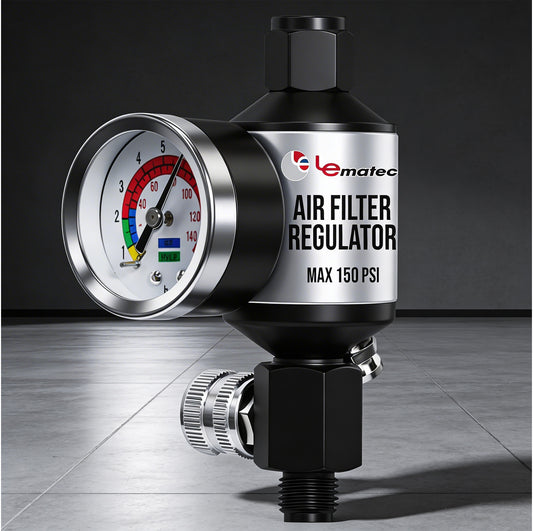




A 1/4-inch regulator looks fine right up until your impact wrench hits like a tired ratchet or your blast cabinet starts starving for air. That is usually the moment people ask, what size air regulator needed for the tool, the hose, and the compressor they already own. The short answer is this: regulator size is not just about thread size. It is about flow.
If you size a regulator only by whatever fits the inlet, you can end up with pressure drop, weak tool performance, and a setup that never feels right no matter how high you crank the knob. The better approach is to match the regulator to the air demand of the tool and the layout of the system. For most hand air tools, a 1/4-inch or 3/8-inch regulator is enough. For high-demand tools and blasting setups, 1/2-inch and larger often make more sense.
For common shop tools, the answer depends on CFM first and fitting size second. A small regulator can still be the wrong choice even if it threads on perfectly.
A 1/4-inch regulator is usually fine for light to moderate air use. Think tire inflators, small air ratchets, blow guns, and some trim or hobby tools. If the tool has low CFM demand and short duty cycles, 1/4-inch can work without much trouble.
A 3/8-inch regulator is the safer choice for many general-purpose shop setups. It is a strong fit for impact wrenches, air hammers, die grinders, drills, and similar tools used in automotive or fabrication work. If you want one regulator that covers a lot of day-to-day pneumatic tools without becoming a bottleneck, 3/8-inch is often the sweet spot.
A 1/2-inch regulator is where you start getting into heavier air demand. This size makes sense for continuous-use grinders, sanders, bigger spray setups, and small sandblasting systems. If your tool runs for long stretches instead of short bursts, stepping up in regulator size usually pays off.
For blasting, production air tools, and higher-volume systems, 3/4-inch and larger may be needed. At that point, the regulator is part of the whole air management system, not just an accessory at the tool.
Here is the mistake that causes most sizing problems: treating regulator size and regulator capacity like the same thing. They are related, but they are not identical.
The port size tells you the connection size - 1/4-inch, 3/8-inch, 1/2-inch, and so on. Flow capacity tells you how much air the regulator can actually pass while maintaining usable pressure. Two regulators with the same port size can have different internal design, different pressure drop, and different real-world performance.
That matters because your tool cares about pressure at the tool while air is moving, not static pressure on the gauge with the trigger released. A regulator that looks fine at 90 PSI with no air flowing can drop well below that once the tool is under load.
That is why CFM rating matters so much. If your die grinder needs 8 CFM and your regulator cannot keep up, the grinder slows down. If your blast gun wants much more than the regulator can pass, blasting becomes inconsistent and frustrating fast.
If you want the right answer to what size air regulator needed, check these three things before you buy.
First, look at the tool's CFM requirement at working pressure. Not just maximum compressor PSI. The important number is how much airflow the tool needs to perform correctly, usually at 90 PSI for many air tools.
Second, consider how the tool uses air. An impact wrench can have a fairly high CFM number, but it is often used in short bursts. A DA sander, angle grinder, or blast gun pulls air continuously. Continuous-use tools punish undersized regulators much faster.
Third, leave headroom. If a tool needs 8 CFM, do not shop for a regulator that only barely supports 8 CFM under ideal conditions. Give yourself margin so the system can handle hose loss, fittings, and normal variation.
As a practical rule, if you are on the edge between two regulator sizes, go up a size if the tool runs continuously or if you plan to expand the setup later.
You can buy the right regulator and still choke the system with undersized hose or restrictive quick-connects. This is common in home garages and small shops.
A 1/2-inch regulator feeding a skinny 1/4-inch hose to a high-demand grinder will not perform like a true 1/2-inch air path. The smallest restriction in the chain often becomes the real limit. That includes couplers, swivels, water separators, manifolds, and even cheap fittings with narrow internal passages.
For lighter tools, 1/4-inch hose and fittings are often acceptable. For stronger impacts, grinders, sanders, and other higher-demand tools, 3/8-inch hose is often a better match. For larger blasting and production-style setups, many users move to 1/2-inch plumbing or larger to avoid pressure drop.
If your tool feels weak even though the compressor should be big enough, check the whole path. The regulator may not be the only problem.
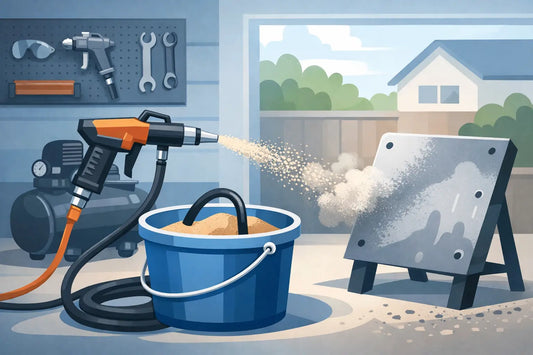
Sandblasting is where sizing mistakes get expensive. A blast gun that is starved for air does not just run poorly. It wastes time, media, and patience.
Most blasting setups need more than a small general-purpose regulator. A 1/2-inch regulator is a common starting point for many blast cabinet and portable blasting applications, but some setups need 3/4-inch or larger depending on nozzle size and compressor output. The larger the nozzle and the longer the run time, the more important high flow becomes.
Blasting is not a quick-burst job. It is sustained demand. That means the regulator, filter, hose, and compressor all need to support the load together. If one component is undersized, the whole setup suffers.
Moisture control also matters more in blasting than many buyers expect. A regulator alone does not solve wet air. If you are blasting, especially for any length of time, pairing the regulator with proper filtration and moisture control is usually the smarter move.
That depends on how you work.
A main regulator at the compressor or wall line is good for setting overall shop pressure. It gives you a controlled base level and can protect downstream equipment from excess pressure. But that does not always mean each tool is seeing the exact pressure it wants.
Point-of-use regulators make more sense when different tools need different settings. That is especially useful if you switch between inflating tires, running an impact, using a spray gun, or setting up a blast cabinet. Fine control at the tool or workstation is easier and usually more accurate.
In many shops, the best answer is both: a properly sized main regulator for the system and smaller dedicated control where precision matters.
The biggest mistake is buying by port size alone. The second is assuming bigger PSI numbers mean better tool performance. If the airflow is not there, extra pressure setting will not fix it.
Another common issue is choosing a mini regulator because it is compact and cheap, then trying to run a grinder or sander through it. Small regulators have their place, but not on tools that live on airflow.
People also forget future use. If you are already close to needing a 3/8-inch regulator, buying another 1/4-inch unit to save a little money now often means replacing it later.
If you use mostly light-duty tools, start with a quality 1/4-inch regulator and verify that its flow rating covers your actual CFM needs. If your shop runs common automotive and fabrication tools, 3/8-inch is often the practical default. If you run sanders, grinders, paint prep tools, or blasting equipment, 1/2-inch deserves a hard look. For bigger blasting and sustained high-flow work, 3/4-inch and up may be the right move.
The best regulator is not the smallest one that threads on. It is the one that lets the tool work like it should, without pressure sag, wasted air, or constant adjustment. That is the kind of purchase that saves time every time you pull the trigger.
If you are unsure, size for the heaviest air-hungry tool you actually use, not the lightest one in the drawer. That usually leads to fewer headaches and a shop setup that works the first time.








 AIR REGULATORS

 ACCESSORIES