Shopping Cart
(0)
Free shipping included — no minimum on any US order

Quick Search:



That moment when an exhaust clamp won’t budge and the pipe is already half-crushed from someone’s last attempt is when a good cut stops being “nice to have.” You don’t need to torch your way through a muffler shop problem, and you don’t need to spend an hour fighting a saw that chatters, binds, and throws sparks into everything under the car. The right pneumatic cutter can turn exhaust work into a clean, controlled, predictable step.
The job you’re really trying to accomplish is not “make pipe shorter.” It’s cut the pipe without crushing it, without wandering into surrounding brackets or heat shields, and without leaving a jagged edge that makes the next step harder. Exhaust work is full of tight clearances, inconsistent thickness, rust scale, and awkward angles. That’s why tool choice matters.
The trade-off is speed. A body saw is controlled, not fast. On thick stainless or heavily rusted pipe, it can feel like you’re polishing the metal instead of cutting it unless you use the right blade and keep your air supply steady.
This option shines when you’re cutting close to a resonator, near a fuel tank shield, or anywhere you’d rather be slow than sorry.
The trade-offs are sparks, noise, and the need for clearance. Cut-off wheels also punish side-loading. If you twist the wheel in the cut to “help it along,” you can shatter it, bind it, or gouge the pipe.
If you’re cutting multiple sections for a custom job, or you’re dealing with clamp sleeves and you just want it separated cleanly, the cut-off tool is usually the productivity play.
If your compressor can’t keep up, you’ll feel the cutter bog down mid-cut, which increases heat, makes the blade or wheel wander, and forces you to push harder. Pushing harder is where pipes get crushed in stands, wheels get pinched, and cuts get ugly.
A few practical rules that keep pneumatic cutters happy:
Use a hose with enough inside diameter for the tool. Long, skinny hoses starve cutters.
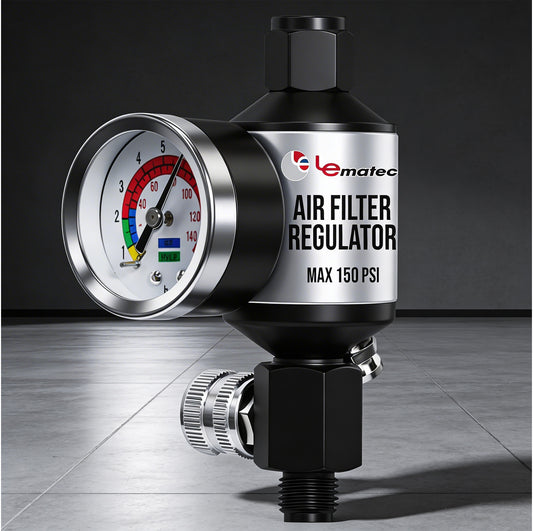
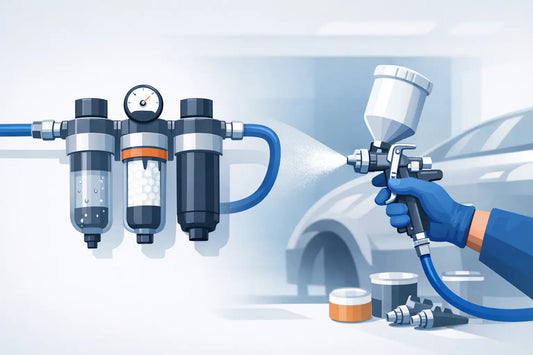
Run a filter and moisture control. Water in the line shortens tool life and can make performance inconsistent.
Set pressure at the tool, not just at the tank. If you’re set to 90 PSI at the compressor and you lose 15 PSI through hose and fittings, the tool is working half a day in the penalty box.
Also, oil matters. If your pneumatic tools are designed for inline oiling, use it. A dry cutter may still run, but it won’t run strong for long.
Start by deciding what “straight” means for your next step. If you’re clamping, you can tolerate a slightly wider kerf and a minor angle. If you’re welding, you want a square cut that fits tightly.
Mark your cut. A wrap-around strip of paper or tape can help you transfer a straight line around the pipe, especially if you’re working on the ground and eyeballing it.
Support the pipe. If the exhaust is hanging on rubber mounts, the pipe will vibrate and flex. Use a stand, a block, or a strap to keep it from bouncing. Vibration makes blades skip and wheels chatter.
Make a shallow starter groove. With a cut-off wheel, lightly score the line first so the wheel tracks. With a body saw, start slow and let the teeth bite before you increase speed.
Let the tool do the work. The “push through it” instinct is what bends thin tubing and binds blades. Keep steady pressure and keep the cutter aligned.
Finish the edge. A quick deburr with a grinder or file saves time later when you’re sliding on a coupler or trying to seat a clamp. If you’re welding, clean back to bright metal so contamination doesn’t ruin your bead.
If you’re burning through cut-off wheels, you may be twisting in the cut or using a wheel that’s too thin for how you’re handling it. Thin wheels cut fast but hate side load. A slightly thicker wheel can last longer if your working angle isn’t perfect.
If a body saw feels painfully slow, check blade selection. Teeth-per-inch matters. Fine-tooth blades can be smooth but slow on thicker material, while a more aggressive tooth count can bite better in exhaust tubing - especially when rust is involved.
If stainless is taking forever, that’s normal up to a point. Stainless work-hardens when you overheat it. Keep the tool moving, avoid excessive pressure, and don’t “polish” one spot.
Eye protection is non-negotiable. Rust scale and abrasive grit don’t care that you’re “almost done.” Hearing protection is smart because cut-off tools are loud, and your head is usually close to the work.
Watch what’s behind the cut. Heat shields, wiring, rubber fuel lines, and brake lines can be closer than they look from your angle. If you can’t see the back side, reposition or shield it.
If you’re cutting an old exhaust, expect sharp edges. Thin-wall tubing can leave a razor-like lip after the cut. Gloves help, but don’t rely on gloves to save you from a wheel.
It depends, though. If you’re doing a one-off driveway job with no compressor, a cordless option may be simpler. If you’re doing precision fabrication on a bench with perfect access, a band saw or chop saw can make cleaner, squarer cuts than a handheld tool.
But for real-world exhaust repairs and modifications - rust, limited access, awkward angles, and the need to keep moving - pneumatic cutters are in their element.
Tool profile matters under a vehicle. A slightly smaller head and better trigger control can beat raw power on paper.
Consumables are part of the system. Make sure the tool uses common blade sizes or wheel diameters so you’re not stuck hunting for refills.
Finally, pay attention to the supplier’s support, not just the price. A cutter is only a deal if it shows up fast and stays working. If you’re shopping for pneumatic cutters, grinders, and the supporting accessories that keep air tools running right, Pro Air Tools focuses on job-ready pneumatic equipment with a free 36-month warranty and fast 1-day order shipping - the kind of operational backing that matters when the car is already on the lift.
Cutting an exhaust pipe is rarely the “fun” part of the job, but it can be the easiest part when your air supply is steady, your cutter matches the access you have, and you’re not forcing the tool to do something it was never meant to do.
Factory direct from Le Lematec — professional quality, competitive prices.



 AIR REGULATORS

 ACCESSORIES