Shopping Cart
(0)
Free shipping included — no minimum on any US order

Quick Search:


If you work on cars, machines, or any bolted assembly, you've probably asked yourself: should I get an air ratchet or an impact wrench? It's one of the most common questions we hear from both hobbyists and professional technicians — and the answer isn't always obvious.
The short version: these tools do different jobs. An air ratchet is built for speed and access in tight spaces, while an impact wrench is built for raw breaking torque. Most serious shops end up owning both. Here's how to figure out which one you need first.
An air ratchet looks and works like a hand ratchet, but with a pneumatic motor doing the turning for you. It spins fasteners quickly at moderate torque — typically between 25 and 70 ft-lbs depending on the model. The real advantage is speed: instead of manually ratcheting a bolt 30 times, an air ratchet zips it out in seconds.
Where air ratchets truly shine is in confined spaces. Their slim profile fits into areas where an impact wrench physically cannot reach. Think dashboard bolts, interior trim fasteners, valve covers, intake manifolds, and any work inside engine bays where clearance is measured in fractions of an inch.
Common tasks for an air ratchet include removing and installing fasteners on brake calipers, alternators, water pumps, interior panels, and engine accessories. If the bolt isn't seized or torqued to extreme specs, an air ratchet handles it faster than any other tool in your box.
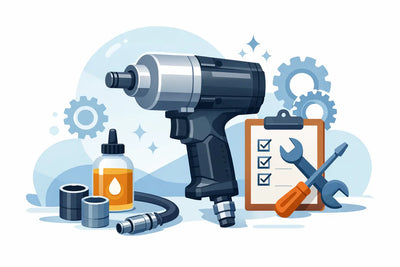
An impact wrench delivers short, high-energy hammer blows to break stubborn fasteners loose. A good 1/2" impact wrench delivers 800 to 1,000+ ft-lbs of breakaway torque — roughly 15 to 20 times more than an air ratchet. That concussive action is what separates frozen lug nuts from the ones that won't budge for anything else.
Impact wrenches are essential for suspension work, wheel removal, axle nuts, crank bolts, exhaust manifold studs, and any fastener that's been torqued to spec or corroded in place. They're also the fastest way to remove lug nuts during tire rotations and brake jobs.
The trade-off is size. Impact wrenches are bulkier, heavier, and require more air volume (CFM) from your compressor. They also consume more air per cycle, which matters if you're running a smaller compressor.
| Feature | Air Ratchet | Impact Wrench |
|---|---|---|
| Torque Range | 25–70 ft-lbs | 800–1,000+ ft-lbs |
| Best For | Speed-running fasteners in tight spaces | Breaking frozen or high-torque bolts |
| Size & Weight | Compact, 2–3 lbs | Bulky, 5–8 lbs |
| Air Consumption | 3–4 CFM | 5–7 CFM |
| Noise Level | Moderate | Loud |
| Typical Drive Size | 3/8" or 1/2" | 1/2" |
| Price Range | $80–$165 | $150–$300+ |
If you mostly do general maintenance, interior work, and under-hood repairs where fasteners aren't seized, start with an air ratchet. You'll use it on 80% of bolts you encounter, and the time savings over a hand ratchet are dramatic.
If you do suspension work, wheel service, or deal with rusted and seized fasteners regularly, an impact wrench is non-negotiable. No amount of hand effort or ratchet speed replaces the breaking torque of an impact.
If you can only buy one tool today and you work on cars: get the impact wrench first. You can always use a hand ratchet for tight-space work in the meantime, but there's no manual substitute for 1,000 ft-lbs of breakaway torque.
We carry both categories. Here's a quick look at what's available:
Air ratchets and impact wrenches aren't competing tools — they're complementary ones. The ratchet handles volume and access; the impact handles force. Professionals keep both within arm's reach because together they cover virtually every fastener situation you'll encounter.
Start with whichever matches your most common work, then add the other when the budget allows. Either way, you're replacing hand effort with pneumatic speed, and that's time you get back on every single job.


 AIR REGULATORS

 ACCESSORIES