Shopping Cart
(0)
Free shipping included — no minimum on any US order

Quick Search:
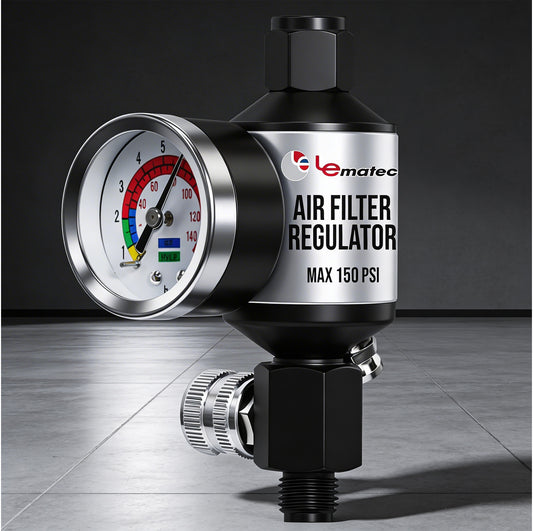
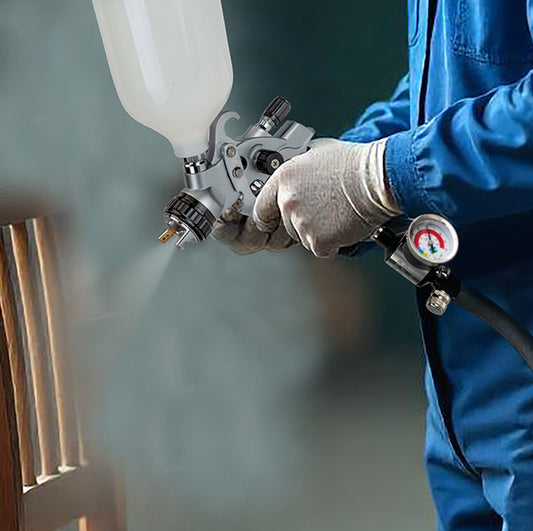


A digital air pressure regulator replaces the guesswork of analog gauges with a precise LCD readout. For spray painting, powder coating, and any finish work where pressure accuracy matters, digital regulators deliver consistent results that analog dials simply cannot match.
This guide covers what makes digital regulators different, how to choose between models, and where they make the biggest difference in your workflow.
Analog gauges have a fundamental problem: parallax error. Depending on your viewing angle, the needle can appear to point at different values. Add in vibration drift and the gauge bouncing during compressor cycling, and you might be painting at 35 PSI when you thought you were at 30. That 5 PSI difference is the line between a smooth finish and orange peel texture.
Digital regulators eliminate this entirely. The LCD displays an exact number — no squinting, no guessing, no angle-dependent readings. Most units also offer multi-unit switching between PSI, BAR, and KPA, which is useful if you're following European equipment specifications or paint manufacturer data sheets that list pressure in BAR.
These mount directly in your air line between the compressor and the tool. The DAR01B and DAR02B are inline units that control pressure for all downstream tools. They're ideal as the main pressure control point near your compressor.
Designed to mount directly at the spray gun or tool, these give you tool-specific pressure control. The DAR03B features a compact design and backlit LCD for reading pressure in dim spray booths. The AR-08 is another point-of-use option specifically designed for spray guns.
For budget-conscious setups or environments where electronics aren't ideal (extreme heat, chemical exposure), analog regulators like the AR-01 and AR-02 remain solid workhorses. They lack the precision of digital readouts but cost less and need no batteries.
Match the regulator's range to your work. Most spray guns operate between 10–50 PSI, while pneumatic tools like impact wrenches and die grinders need 90 PSI. The DAR01B and DAR02B handle up to 160 PSI, covering virtually all applications.
Diaphragm regulators provide smoother, more consistent pressure with less downstream fluctuation. All the Le Lematec digital regulators use diaphragm control for this reason. Piston-type regulators are cheaper but allow more pressure creep over time.
Look for backlit LCDs if you work in spray booths or under cars. Multi-unit display (PSI/BAR/KPA) saves conversion math. Battery life should be 12+ months of normal use — most digital regulators use CR2032 coin cells.
Some regulators combine filtration with pressure control. The AI303-R2 includes a water separator and digital pressure gauge in a single unit, reducing connection points and simplifying your air line. The AI303-R1 offers the same combination with an analog gauge at a lower price point.
HVLP guns are extremely pressure-sensitive. A 2 PSI variation changes the spray pattern, droplet size, and finish quality. Digital regulators ensure you're at exactly the manufacturer-specified pressure every time.
Fluidized bed and spray gun powder coating systems need tight pressure control for even coverage. Digital readouts let you dial in repeatable settings across batches.
Detail airbrushing operates at very low pressures (5–20 PSI) where analog gauges are essentially unreadable. A digital regulator with 0.1 PSI resolution transforms airbrush control.
In professional shops, documenting spray pressures is part of quality records. A digital readout gives you an exact number to log, rather than "about 28 PSI."
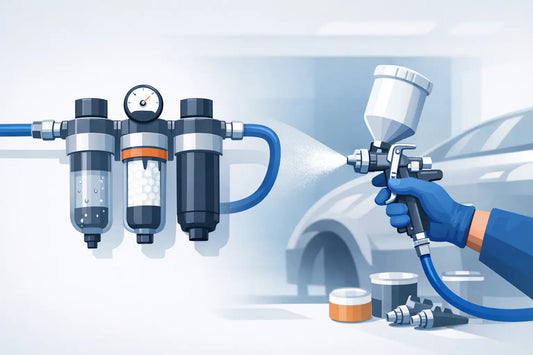
Always install an inline air filter before the regulator. Moisture and particulates damage diaphragm seals and can fog LCD displays. For best results, combine a filter like the AI-304 or ZN312-D desiccant dryer upstream of your regulator.
Use Teflon tape on all NPT connections. Set your compressor's tank pressure 20–30 PSI above your working pressure to give the regulator headroom to maintain steady output during demand spikes.
Yes. Digital regulators eliminate parallax error and provide readings accurate to within 1% of full scale. Analog gauges typically have 2–3% accuracy and are subject to reading errors based on viewing angle.
Yes, most use a CR2032 coin cell that lasts 12–18 months. The regulator still controls pressure mechanically if the battery dies — you just lose the digital readout.
They're all units of pressure. 1 BAR equals 14.5 PSI, and 1 KPA equals 0.145 PSI. Digital regulators with multi-unit displays let you switch between them, which is useful when following international equipment specs.
Yes, as long as the regulator's pressure range covers your tool's requirements. A 160 PSI regulator handles everything from low-pressure airbrushes to high-demand impact wrenches.







 AIR REGULATORS

 ACCESSORIES