Shopping Cart
(0)
Free shipping included — no minimum on any US order

Quick Search:
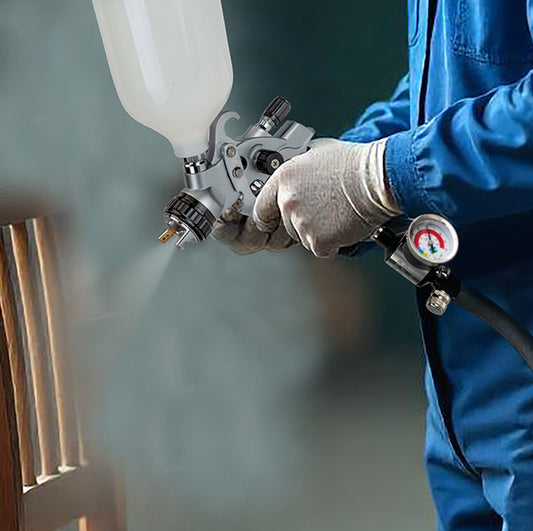


Spray painting with an air compressor demands precise, consistent air pressure. Too much pressure causes orange peel texture and overspray waste. Too little pressure produces sputtering and uneven coverage. Your compressor's built-in regulator lacks the fine control needed for quality finishes — it's designed for nail guns and impact wrenches, not spray work.
An inline air regulator installed between your compressor hose and spray gun gives you the precision control that makes the difference between a professional finish and a weekend mess. Here's how to choose the right one.
Different spray work requires different pressure ranges. Getting this right is the single biggest factor in spray finish quality:
Notice the tight ranges — being off by just 3-5 PSI can ruin a finish. This is why a quality inline regulator with a readable gauge is essential, not optional.
Digital regulators like the Le Lematec DAR02B display exact PSI on an LCD screen, eliminating the guesswork of reading a small analog gauge in a poorly-lit garage. The DAR02B reads to 0.1 PSI accuracy across a 0-160 PSI range, making it ideal for dialing in the precise pressures spray painting demands. It also features a 1/4" NPT connection that fits standard spray gun setups.
The Le Lematec DAR01B is another excellent option with multi-unit display (PSI, BAR, KPA, KG/CM2) — useful if you're following European spray gun specifications.
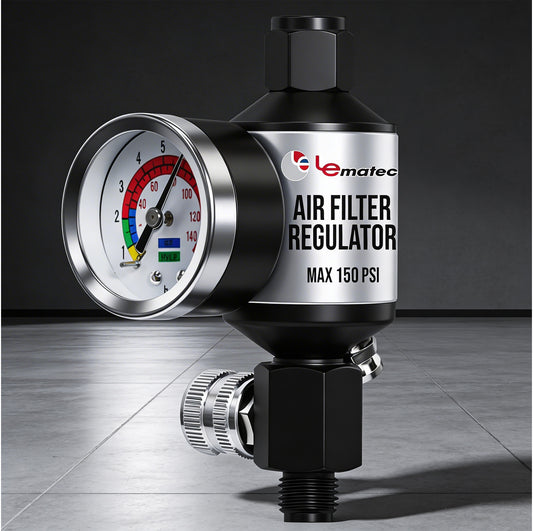
The Le Lematec AR-01 and AR-02 are traditional diaphragm-type regulators with mechanical gauges. They're reliable, require no batteries, and cost less. The AR-01 at $18.45 is a solid entry point for hobbyists. However, reading exact PSI values on a 1.5" analog gauge can be challenging, especially in the 25-35 PSI range where most spray work happens.
Pressure alone isn't enough — your compressor also needs to deliver sufficient air volume (CFM) for continuous spray painting. Most HVLP spray guns require 8-15 CFM at 25-30 PSI. If your compressor can't keep up, pressure will drop mid-pass, creating visible banding in your finish.
A good inline regulator helps here too: by reducing pressure to only what your gun needs, you reduce CFM demand and help your compressor keep up. The Le Lematec regulators handle up to 22 CFM, which covers any hobby or semi-professional spray setup.
| Model | Type | Price | Best For |
|---|---|---|---|
| DAR02B | Digital | $29.98 | Automotive / precision work |
| DAR01B | Digital | $30.98 | Multi-unit / international specs |
| AR-01 | Analog | $18.45 | Budget / hobby |
| AR-02 | Analog | $20.95 | General purpose |
Browse all regulators: Shop Air Regulators Collection
For most automotive spray painting, set your regulator between 26-32 PSI at the gun. Base coats typically need 26-29 PSI, while clear coats perform best at 28-32 PSI. Always test on scrap material first and adjust based on the spray pattern. Stains and lacquers use lower pressures (15-25 PSI), while latex paints need higher pressure (40-50 PSI).
Digital regulators are recommended for spray painting because they provide exact PSI readings (to 0.1 PSI), which matters when the difference between a good finish and a bad one is just 3-5 PSI. The Le Lematec DAR02B digital regulator ($29.98) is popular among spray painters for its LCD accuracy and easy adjustment. Analog regulators work fine for less precision-critical work.
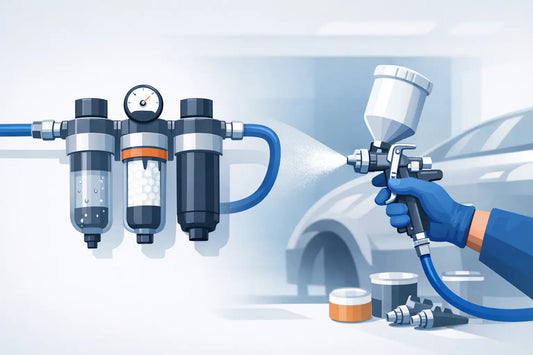
Yes, absolutely. Moisture in your air line causes fish eyes, craters, and adhesion failures in paint finishes. Install an inline moisture filter/separator before your regulator. The Le Lematec ZN312 ($16.99) or ZN312-D-C1 desiccant filter ($17.99) removes water and oil from compressed air, which is essential for any spray painting work.
All products ship free to the US with same-day processing.







 AIR REGULATORS

 ACCESSORIES