Shopping Cart
(0)
Free shipping included — no minimum on any US order

Quick Search:




Moisture in a compressed air line usually shows up right when you can least afford it. Paint starts fisheyeing, a blast cabinet clumps media, an impact wrench loses consistency, or a tire inflator spits water into the line. If that sounds familiar, an inline air dryer for compressor setups is not an extra accessory. It is often the fix.
For a lot of shops and garages, the real question is not whether moisture is bad. Everyone knows it is. The question is whether a small inline dryer is enough, or whether the problem needs a larger filtration and drying setup. That depends on your compressor, your climate, your duty cycle, and what tools you are running.
Compressed air naturally creates condensation. When your compressor squeezes air, it raises the air temperature. As that hot compressed air cools in the tank and lines, water vapor turns into liquid. That moisture then travels downstream unless something removes it.
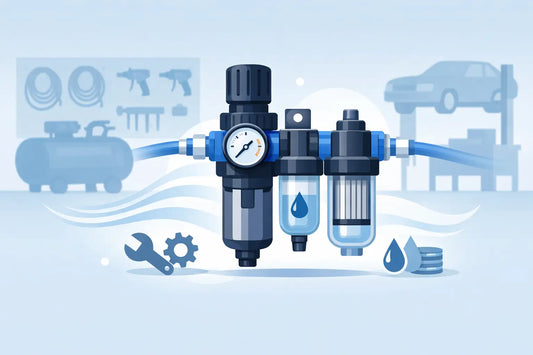
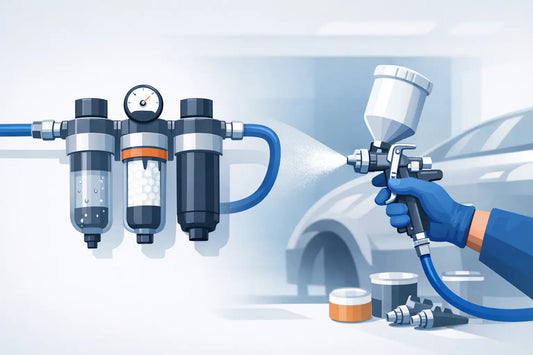
An inline air dryer for compressor systems is installed in the air path to reduce that moisture before it reaches your tool, hose, or application. In simpler setups, this may be a compact dryer or filter-style unit mounted close to the point of use. In more demanding systems, it may work alongside a regulator, water separator, and coalescing filter.
That distinction matters. Some buyers use the term air dryer to describe any device that keeps water out of the line. In practice, there is a difference between a basic moisture separator and a true drying stage. A separator knocks out bulk liquid water. A dryer reduces remaining moisture vapor to a lower level. If you are doing precision painting or abrasive blasting in humid conditions, that difference shows up fast.
A little water in the line can turn into several different problems, and they do not all look the same.
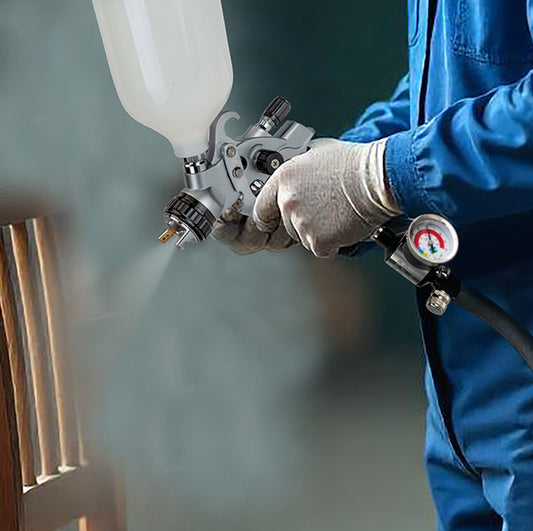
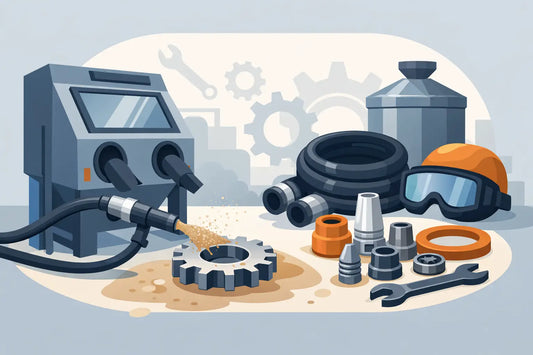
With air tools, moisture encourages internal corrosion, washes out lubrication, and can shorten service life. The damage is often gradual, which makes it easy to ignore until the tool starts losing power or sticking. With blasting equipment, water is more obvious. Media bridges, clogs, and feeds inconsistently. With paint and surface prep, moisture can ruin finish quality and force rework.
The tricky part is that many users drain the tank and assume that should solve it. Draining helps, but it does not stop new condensation from forming as compressed air cools further down the line. That is why point-of-use drying often makes sense, especially for garages and small shops that do not have a full air treatment system.
For many buyers, an inline setup is the right middle ground. It is compact, affordable, and easy to add without rebuilding the whole air system.
If you run a home garage, small fabrication space, maintenance bay, or light automotive setup, an inline air dryer can do the job well when the air demand is moderate and the application is localized. It is especially useful when you have one moisture-sensitive task, like painting a panel, running a blast gun, or protecting a higher-value pneumatic tool.
It also makes sense when the compressor itself is decent but the air treatment is minimal. A lot of portable and mid-size shop compressors produce workable air for general tasks, but once humidity rises or run times increase, moisture starts reaching the hose. An inline dryer gives you a practical correction without adding a large refrigerated dryer or dedicated multi-stage plant system.
This is where buyers can waste money by buying too small.
If your compressor runs long cycles, supports multiple stations, or feeds high-CFM applications all day, a small inline dryer may be overwhelmed. The same goes for hot, humid shops where water load is consistently high. In those cases, a point-of-use dryer helps, but it may only mask a larger system problem.
You may need better aftercooling, more line length for cooling, a proper tank drain routine, a separator at the tank, and a staged filter and dryer setup farther downstream. If you are seeing heavy water in several tools, not just one, the issue is probably system-wide.
That does not make inline units a bad buy. It just means they work best when matched to the job rather than used as a catch-all fix.
The first thing to check is airflow. If the dryer cannot keep up with your tool's CFM demand, pressure drop becomes the next problem. You solve moisture but lose performance. For impact wrenches, grinders, sanders, and blast equipment, that trade-off can be just as frustrating as water in the line.
Next, look at the application. General air tool protection does not require the same dryness level as paint spraying or abrasive blasting. If the goal is protecting a ratchet or inflator, a basic inline drying and filtration stage may be enough. If you are chasing finish quality or trying to keep blasting media dry, you want a more capable moisture-control setup.
Placement matters too. Putting a dryer directly on a hot compressor outlet is usually not ideal because hot air carries more moisture vapor, and some compact units work better after the air has had time to cool. In many setups, a better approach is to let air travel through some line, drop out bulk water with a separator, and place the inline dryer closer to the point of use.
Serviceability is another factor buyers overlook. Dryers and filters need maintenance. If the unit is hard to inspect, drain, or replace, it tends to get ignored. A simple setup that gets serviced on time is usually better than a more complicated one that does not.
A lot of buyers shopping air accessories end up comparing a dedicated inline dryer with a standard filter regulator combo. They are related, but they are not identical.
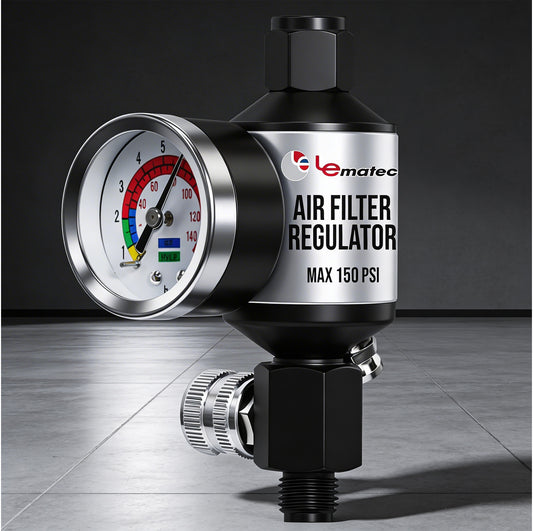
A filter regulator combo is excellent for controlling pressure and removing some liquid water and debris. It is a smart foundation for many pneumatic setups. But if your real problem is persistent moisture vapor making it past the filter, a basic combo unit may not be enough by itself.
That is why many practical systems stack functions. You regulate pressure, separate bulk water, and then add drying where the air quality needs to be cleaner. For a small shop, that can be a cost-effective way to improve air quality without overbuilding the system.
If you are not sure whether the issue is serious enough to justify an upgrade, the symptoms are usually easy to spot. Water at couplers, fog or mist from tools, finish defects while spraying, inconsistent blasting flow, and recurring rust inside pneumatic tools all point to moisture getting downstream.
Seasonal performance changes are another clue. If the system works acceptably in winter but starts causing trouble in summer, humidity is probably pushing a marginal setup over the edge. That is often where an inline dryer earns its keep.
Air accessories tend to get bought as low-attention items. That is usually a mistake. When drying and filtration fail, the damage spreads into tool performance, finish quality, and project delays. A cheap part that cannot keep up is not saving money if it creates downtime.
For most buyers, the better approach is to match the dryer to the actual workload and buy from a supplier that treats support, speed, and reliability as part of the product. That matters even more when you are stocking a working garage or small shop and cannot afford to wait around for replacements.
At Pro Air Tools, that is the point of carrying practical air system components alongside the tools they protect. You are not just buying a fitting to put in the line. You are solving a moisture problem that can slow down the whole job.
An inline air dryer for compressor setups is not always the full answer, but it is often the right next step. If your tools are seeing occasional moisture, your blasting media is clumping, or your finish work is getting unpredictable, adding drying at the right point in the system can clean up a lot of problems fast.
The key is to be honest about your air demand. Buy for the way you actually work, not the way you hope the system performs on a perfect day. Dry air is one of those upgrades that feels small until the job starts running the way it should.
Factory direct from Le Lematec — professional quality, competitive prices.
All products ship free to the US with same-day processing.





 AIR REGULATORS

 ACCESSORIES