Shopping Cart
(0)
Free shipping included — no minimum on any US order

Quick Search:




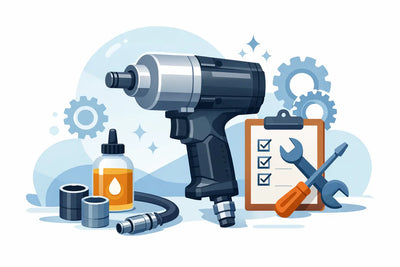
That moment when a lug nut laughs at your breaker bar is usually when people stop shopping for “a tool” and start shopping for uptime. An air impact wrench is the shortcut to getting stubborn fasteners moving without turning every job into a full-body workout. But the wrong impact can be just as frustrating - either it won’t break loose what you need, or it hammers so hard you snap studs, round hardware, or beat up your wrists.
This is the practical way to choose and run an air impact wrench so it actually solves problems in the shop, garage, or on a maintenance cart.
That “hammering” is also why impacts can be forgiving on your compressor compared to trying to muscle a stuck bolt with a constant high-load tool. The trade-off is control. Impacts are excellent at loosening and fast run-down, but they can over-tighten quickly if you treat them like a torque wrench.
A good way to think about it: if you do mostly passenger-car lug nuts and general automotive work, you don’t need the biggest monster available. If you’re doing suspension, rusty truck hardware, fleet work, or heavy equipment maintenance, you need headroom - and you need an air system that can feed it.
A 3/8-inch impact is a sweet spot for engine bay fasteners, small brackets, and tighter areas. A 1/2-inch impact is the workhorse for wheels, brakes, and most general shop use. Move up to 3/4-inch when you’re dealing with larger fasteners regularly (think truck suspension, heavy trailers, industrial maintenance). One-inch impacts are specialized - big air demand, big hardware, and usually not the first purchase for a mixed-use garage.
It depends on what you touch every week. If you’re only occasionally hitting larger hardware, a strong 1/2-inch plus good technique and penetrant can cover a lot.
The catch is that “rated” numbers often assume ideal air pressure at the tool with enough flow behind it. If your regulator is set low, your hose is restrictive, or your fittings are tiny, the tool won’t feel like the ad.
Pressure is easy to understand, and it’s easy to get wrong. If you set your regulator to 90 PSI at the wall but lose pressure through a long hose, quick couplers, and a filter, the tool might be seeing 70-80 at impact. Flow is even more important: if your compressor can’t keep up with the CFM demand during repeated hits, the tool will start strong and then fall flat.
If you want the impact to hit consistently, use a short, appropriately sized hose for high-demand tools. For many 1/2-inch impacts, a 3/8-inch ID hose is a common baseline. Step up in hose size for higher demand tools or long runs. Also consider your couplers - restrictive couplers can choke performance more than most people realize.
Extended anvil models help when you need reach past a wheel face or deeper into a pocket, but they can also increase wobble and stress if you’re using poor extensions. If you need reach, prioritize impact-rated extensions and a solid socket fit.
If the tool has multiple power settings, use them. Run fasteners down gently, then finish with a torque wrench when the spec matters. For disassembly, start lower if you’re worried about snapping a small bolt, then increase if it’s not moving.
Extensions matter too. A long extension can act like a torsion spring, soaking up impact energy and reducing breakaway performance. That doesn’t mean “never use extensions,” it means be realistic: if a fastener is stubborn, shorten the stack, use a wobble extension only when you must, and make sure everything is impact-rated.
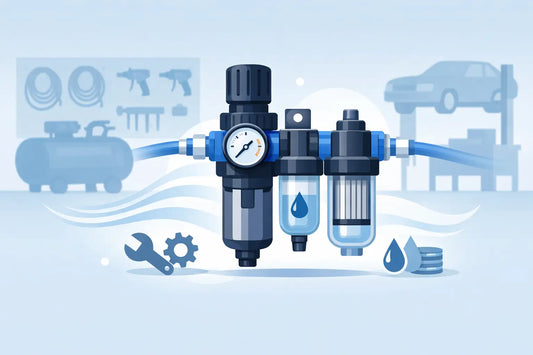
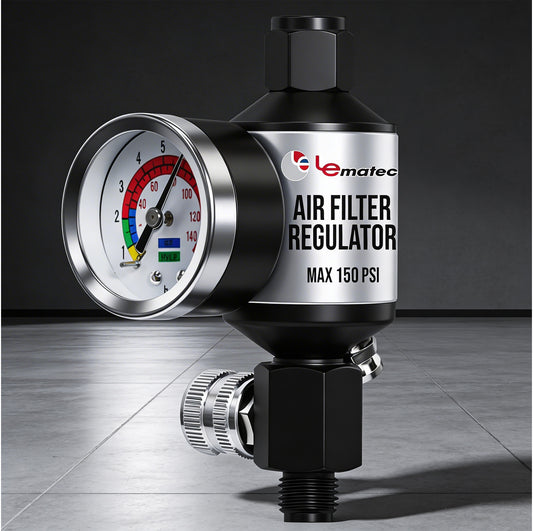
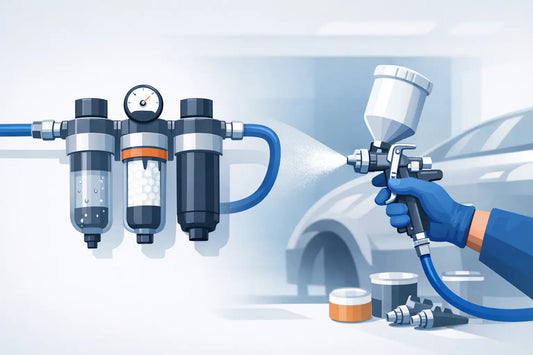
At minimum, run a filter and keep water drained from the tank. If you’re running tools daily, a regulator/filter setup is worth it because it stabilizes pressure and keeps junk out of the tool.
For lubrication, you have two common approaches: inline oiling or a few drops of air tool oil in the inlet before use. If you’re in paint prep or sandblasting areas, be careful with oiling because oil carryover can contaminate surfaces. In those environments, people often manage oiling more deliberately rather than fogging oil through the whole system.
The clean method is simple: use the impact for removal and for quick run-down, then torque to spec by hand. If you’re doing wheels all day, torque sticks can help reduce the chance of wildly overdoing it, but they’re still not a substitute for verifying torque when it matters.
If the compressor runs nonstop during impact use, you’re probably right on the edge of flow. In that situation, shorter bursts, letting the tank recover, or stepping up storage capacity can help. Sometimes the fix is as simple as removing a restrictive fitting or switching to a higher-flow coupler set.
Also consider where you measure pressure. Gauge pressure at the tank isn’t the same as pressure at the tool. If you want honest performance, set pressure under flow, not with the trigger off.
If you’re buying direct online, you want clear warranty terms and fast fulfillment because downtime costs more than the tool. That’s why a supplier that backs the tool for the long haul matters. If you’re already building out a pneumatic setup or replacing tired shop tools, you can find air impact wrench options and matching accessories at Pro Air Tools, with a straightforward 36-month warranty and quick ship-out that keeps projects moving.
If you’re a weekend DIYer with a small compressor, a high-demand impact can be disappointing. You might get one strong hit, then wait for recovery. In that case, matching the tool to the compressor is the practical play, even if the torque numbers look less exciting.
If those three line up, an air impact wrench stops being a “nice-to-have” and turns into one of the most time-saving tools in your shop.
The best part is not the noise or the speed. It’s the moment a stuck fastener finally moves, cleanly, and you get back to the job instead of fighting it.
Factory direct from Le Lematec — professional quality, competitive prices.


 AIR REGULATORS

 ACCESSORIES