
Shopping Cart
(0)


 AIR REGULATORS

 ACCESSORIES

Media Blasting for Powder Coat Removal
Powder coat is great right up until you need it gone. Once that finish starts chipping, gets applied too thick, or hides damage underneath, sanding by hand turns into a slow, messy fight. That is why media blasting for powder coat removal is the go-to method for shops, restorers, and serious DIYers who want clean metal without wasting a full day on one part.
The catch is simple. Powder coat is tougher than standard paint, so the wrong media or too much pressure can leave you with warped panels, pitted aluminum, or extra cleanup that eats into the time you were trying to save. If you want a finish-ready surface, your blasting setup matters just as much as the cabinet or pressure pot you're using.
Why media blasting for powder coat removal works
Powder coat bonds tightly and cures into a hard shell. Chemical stripping can work, and burn-off ovens have their place, but both come with trade-offs. Chemicals add disposal issues and often need scraping after the coating softens. Heat can affect thin parts, baked-in contaminants, or certain assemblies with bushings and seals still installed.
Media blasting removes the coating mechanically. Instead of softening the finish first, it cuts through the cured layer and breaks it away from the substrate. That gives you more control, especially on brackets, wheels, fabricated parts, frames, and hardware with corners, welds, and recesses that are hard to sand evenly.
For many users, the real advantage is speed plus consistency. A properly matched media and air setup can strip powder coat far faster than hand tools while leaving a predictable surface profile for repainting, re-coating, or inspection.
Choosing the right blasting media
There is no single best media for every powder-coated part. The right choice depends on the coating thickness, the base metal, and what the part needs to look like after blasting.
Aluminum oxide is a common choice when you need aggressive cutting action. It works well on stubborn powder coat and holds up for repeated use in cabinet systems. It also leaves an anchor profile that can help with adhesion if the part is being recoated. The trade-off is that it can be too aggressive for delicate aluminum or thin sheet metal if pressure and distance are not controlled.
Crushed glass is another solid option. It cuts well, leaves a cleaner profile than some heavier abrasives, and is often a practical middle ground for steel parts, fabricated components, and general refinishing work. It is less durable than some reusable cabinet media, but many users like how efficiently it removes coating without being overly slow.
Glass bead is usually better when the goal is cleaning or producing a smoother cosmetic finish, not heavy stripping. It can remove lighter coatings, but for thick powder coat it is often slower than people expect. If speed matters, glass bead is rarely the first pick.
Plastic media can make sense for softer substrates or parts where substrate preservation is the top priority. It is less aggressive, which helps reduce the risk of damaging softer metals, but it may struggle on thick or well-cured powder coat. If the coating is stubborn, production time goes up fast.
Steel grit and other very aggressive media can remove powder coat quickly, but they are better suited to heavier steel parts where surface roughness is acceptable or even useful. On lighter parts, they can be more punishment than progress.
Matching media to the part
Steel brackets, frames, suspension parts, and fabricated shop components can usually handle a more aggressive media. That makes aluminum oxide or crushed glass a practical choice when the coating is thick or heavily weathered.
Aluminum wheels, trim pieces, motorcycle parts, and thinner castings need more care. You still may use an abrasive media, but pressure, nozzle distance, and dwell time become much more important. On softer metals, the difference between stripped and damaged can be a few extra seconds in one spot.
Sheet metal is where many users get into trouble. Powder coat on body panels or thin covers may come off quickly, but heat buildup and overblasting can warp the part or leave a profile that takes extra prep to smooth out. In those cases, a less aggressive approach or even a different removal method may be the smarter call.
Air pressure, nozzle size, and technique
A lot of powder coat removal problems get blamed on media when the real issue is setup. If pressure is too low, removal is slow and uneven. If pressure is too high, you risk damaging the part and burning through media faster than necessary.
Most powder coat stripping lands in a practical middle range rather than at the highest number your compressor can feed. Hard coatings often need enough pressure to keep the media cutting consistently, but more pressure is not automatically better. On heavy steel parts, you have more room to push. On aluminum and thinner materials, it pays to back down and let technique do the work.
Nozzle size affects productivity as much as pressure. A larger nozzle moves more media and covers more area, but it also demands more CFM. If your compressor cannot keep up, blasting performance drops off and the job takes longer than it should. A smaller nozzle may be slower on paper, yet more efficient in a real garage or small shop where air supply is limited.
Keep the nozzle moving. Work at a steady angle instead of blasting straight down into one spot for too long. Overlapping passes usually strip more evenly than trying to hammer through the coating in isolated patches. If the finish is fighting back, reassess your media or pressure before you just lean harder on the trigger.
Cabinet blasting vs pressure pot blasting
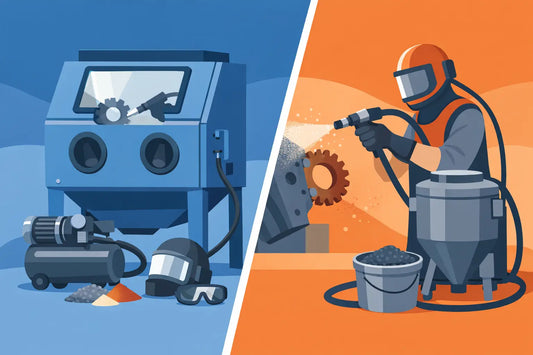
Cabinet blasting makes sense for smaller parts, hardware, fabricated pieces, and any job where media recovery and containment matter. It is cleaner, more economical on reusable abrasives, and easier to control for detail work. If you are stripping batches of brackets, tabs, mounts, or wheel components, a cabinet setup is often the most efficient route.
Pressure pot blasting is the better fit for larger parts, awkward shapes, and outdoor or dedicated blast-area work. It delivers higher output and faster removal on big surfaces, but it also uses more media and needs stronger air support. For frames, rails, larger welded assemblies, and bulky components, that extra production speed usually justifies the setup.
The best choice comes down to the parts you handle most. If your work is repetitive and bench-sized, a cabinet keeps things efficient. If you are tackling oversized parts or restoration work, a pressure pot is hard to beat.
When media blasting is not the best option
Media blasting for powder coat removal is effective, but it is not automatic for every job. Very thin sheet metal can distort. Parts with bearings, seals, threads, or tight internal passages need careful masking and cleanup. Some cast parts can trap media in pockets that are hard to inspect later.
There are also cases where combining methods saves time. If a coating is extremely thick, layered, or chemically resistant, using a stripper first and blasting second can reduce total labor. That is not as clean or as fast to set up, but sometimes it is the more practical move.
If the part has a cosmetic requirement, test first. A hidden section tells you quickly whether the media is too harsh, too slow, or just right. That small step is cheaper than fixing a full wheel, panel, or housing after the fact.
Setup details that make the job easier
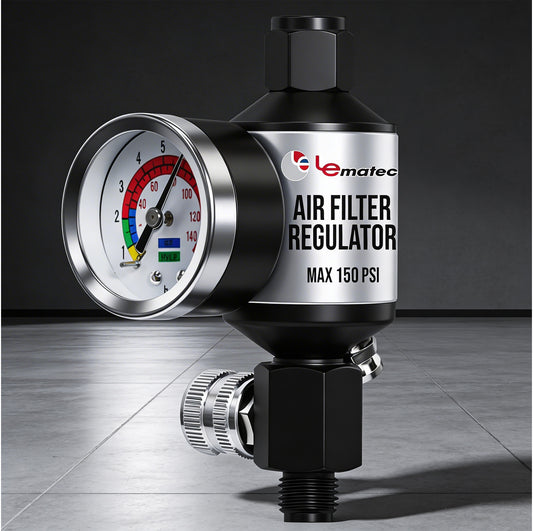
Dry air matters more than many people realize. Moisture in the line causes clogs, inconsistent flow, and wasted time. Good filtration and water control keep media moving and help the blaster work the way it should.
Media condition matters too. Contaminated or broken-down abrasive loses cutting power. If stripping slows down for no clear reason, check the media before assuming the coating changed. Fresh media often restores performance immediately.
Visibility, recovery, and cleanup also affect real job time. The fastest blasting system on paper is not actually fast if you are constantly stopping for clogged lines, poor visibility, or media scattered across the floor. A practical setup is one that lets you keep working without interruption.
That is where buying from a tool supplier that understands shop use makes a difference. Pro Air Tools focuses on the gear, accessories, and air-system support that keep blasting jobs moving, not just the blaster itself.
What to expect after blasting
Once the powder coat is removed, inspect the bare substrate before moving to the next step. Blasting often reveals cracks, filler, poor welds, corrosion, or previous repairs that the coating had hidden. That alone is a big reason many fabricators and restorers prefer blasting over simple scuffing.
If the part is headed for new coating, keep an eye on surface profile. Too smooth, and adhesion can suffer. Too rough, and you may need extra prep before finishing. The right media choice should strip the part and leave a surface that matches the next operation, whether that is primer, paint, or fresh powder.
Powder coat is tough by design, so removal should be treated like a system, not a shortcut. Match the media to the metal, size the air supply honestly, and use a setup that fits the work in front of you. Get those pieces right, and blasting stops feeling like cleanup and starts feeling like progress.
Tags:
Related articles
Air Angle Grinder Disc Selection Made Simple
Jun 15 2026
Pneumatic Cutoff Tool for Sheet Metal
Jun 13 2026
Compressed Air Tool Buying Guide
Jun 11 2026
9 Best Pneumatic Tools for Garage Work
Jun 09 2026
Sandblasting Cabinet vs Siphon Blaster
Jun 07 2026