Shopping Cart
(0)
Free shipping included — no minimum on any US order

Quick Search:


A pneumatic die grinder earns its keep in the jobs that punish slower tools. When you need to clean up a weld, knock down a sharp edge, port a manifold, prep metal in a tight corner, or smooth a surface before paint, this is usually the tool that gets grabbed first. It is compact, fast, and built for control - as long as you match the grinder, accessory, and air setup to the work.
That last part is where buyers either get a tool that works every day or one that feels disappointing from the start. A die grinder can be incredibly effective, but only if you understand what it does best, where straight and angle models differ, and how air supply affects real-world performance.
A die grinder is a precision material-removal tool. It spins small accessories at high speed so you can grind, shape, deburr, sand, or polish with more control than you would get from a larger angle grinder. In automotive work, that often means gasket cleanup, porting, rust removal, weld blending, and reaching spots that a bigger tool simply cannot access. In fabrication and maintenance, it is just as useful for edge cleanup, surface prep, and detail finishing.
The strength of air power here is consistency. A good pneumatic tool stays lighter in the hand than many electric equivalents, runs cool for long sessions, and keeps a simple, durable design. For shops that already have a compressor system in place, it is often the more practical choice for frequent use.
That said, smaller does not mean softer. A die grinder removes material quickly if you use the right bit and keep the speed under control. It is easy to overshoot on thin metal, round over an edge you meant to keep crisp, or load the wrong abrasive and burn up the accessory. This is a finesse tool, not a brute-force one.
The first choice is usually body style. A straight pneumatic die grinder is the better fit when you want direct access in line with the work. It makes sense for internal passages, longer reach, and jobs where pointing the tool straight ahead gives you the cleanest angle of attack. Porting, internal deburring, and reaching inside housings are common examples.
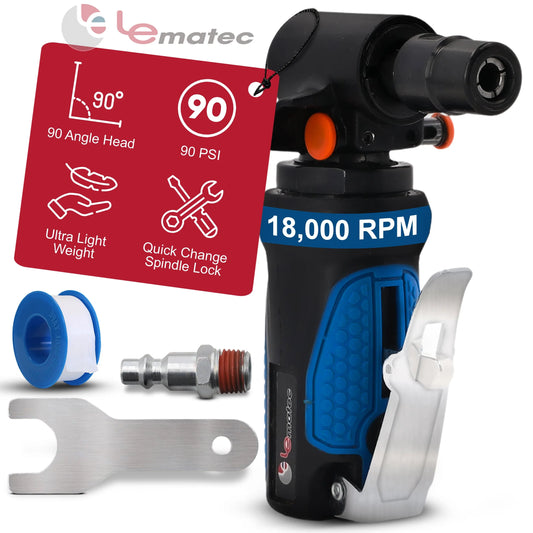
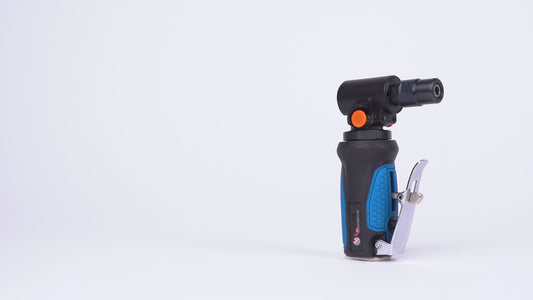
An angle model changes the ergonomics. It is often easier to control on flat surfaces, weld seams, and side-access tasks where your wrist position matters. If you spend a lot of time cleaning up brackets, smoothing external edges, or working in awkward spots under a vehicle, an angle die grinder can feel more natural and less fatiguing.
Neither style is universally better. It depends on where the accessory needs to go and how your hand needs to sit during the cut or grind. Many experienced users end up keeping both because they solve different problems.
Most die grinders are high-RPM tools, and that is exactly why they work so well on detail jobs. High speed lets small abrasives and carbide burrs cut efficiently. But speed without control is also how you chatter a surface, skip across a part, or wear out accessories faster than necessary.
If your work is mostly aggressive stock removal on steel, the grinder needs enough power to hold speed under load. If your work leans more toward polishing, gasket cleanup, or delicate edge blending, controllability matters just as much as top-end RPM. A tool that feels stable and predictable in your hand often delivers better finished results than one that just posts bigger numbers on paper.
Throttle feel matters here. So does overall balance. On repetitive work, a die grinder that is easier to feather and less tiring to hold will usually outperform a heavier, less refined option over the course of a full shift.
A lot of complaints about air tools are really compressor or plumbing problems. If a pneumatic die grinder feels weak, bogs down early, or never seems to hit its expected speed, the issue may not be the grinder at all.
Die grinders need steady airflow. That means your compressor has to supply enough CFM at the required PSI, and your hose, couplers, and fittings cannot choke the tool. Long undersized hoses, restrictive fittings, and moisture in the line all work against performance. If the air system is marginal, the grinder will feel lazy no matter how good the tool itself is.
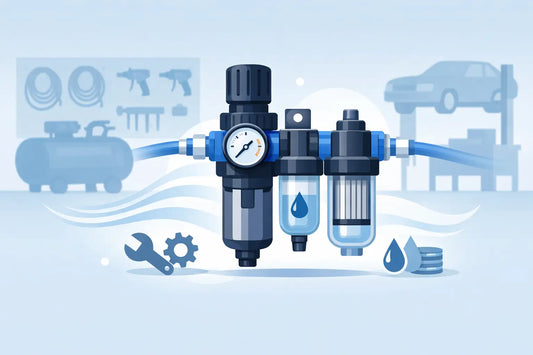
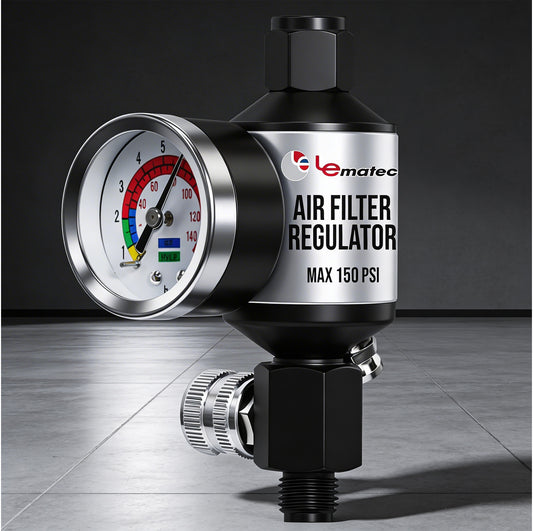
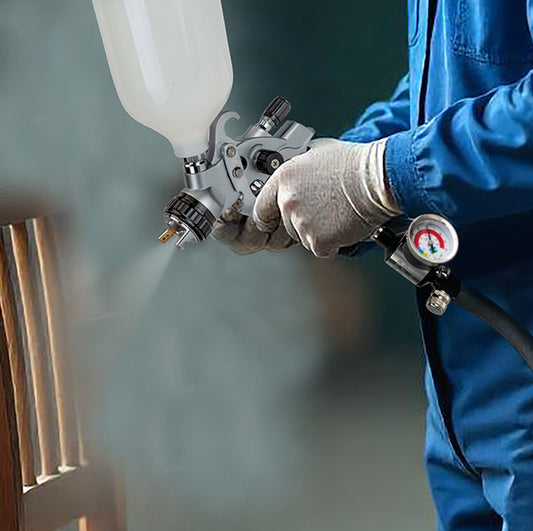
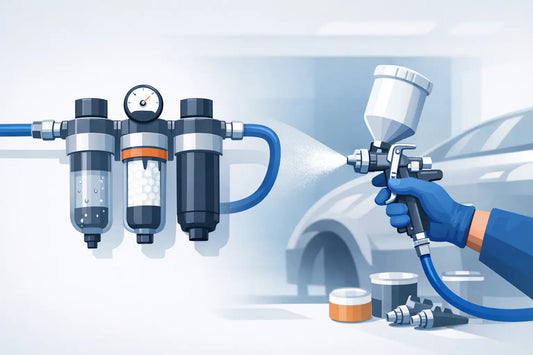
Clean, regulated air also matters for tool life. Water and debris in the line shorten the life of pneumatic tools and can make operation inconsistent. A proper filter and regulator setup is not an extra if you use air tools regularly. It is part of getting the performance you paid for.
For buyers building out a shop, this is worth thinking through before purchase. The right tool on the wrong air setup is still the wrong setup.
Most die grinders are only as useful as the accessories you keep on hand. Carbide burrs handle shaping and material removal. Mounted stones work for grinding and internal cleanup. Flap wheels help with blending and finishing. Roloc-style discs and polishing attachments expand what the tool can do even further, depending on the model and attachment compatibility.
Collet size matters because it determines what shank size accessories you can run. If your work varies, check the accessory ecosystem before you buy. It is frustrating to own a grinder that is fine mechanically but limits your options because the bits you actually need are harder to source or require extra adapters.
It also pays to match the accessory to the material. Aluminum, steel, stainless, and cast iron do not respond the same way. Burr tooth pattern, abrasive type, and working pressure all affect finish quality and cutting speed. If you are doing mixed work, versatility is more valuable than chasing one specialty setup.
If this tool is going to see regular use, focus less on marketing claims and more on practical uptime. You want durable construction, a comfortable grip, predictable throttle response, and a design that stands up to daily shop conditions. A compact body helps in tight spaces, but not if it comes at the cost of control.
Pay attention to air consumption and recommended operating pressure so you can match the tool to your system. Check whether the grinder is built for extended use or more occasional project work. Those are not the same buying decisions.
Support matters too. For working buyers, a bargain tool is not a bargain if it fails mid-job and leaves you waiting. Fast shipping, clear warranty coverage, and access to the matching accessories and air-line components make a bigger difference than a small price gap. That is especially true if this grinder is part of your weekly workflow, not just something for the back shelf.
One of the biggest mistakes is pushing too hard. Let the accessory do the cutting. Excess pressure creates heat, loads the bit, and reduces control. Another common problem is using the wrong speed or attachment for the material, which leads to poor finish quality and shorter accessory life.
Skipping air tool maintenance is another costly habit. A pneumatic die grinder depends on clean air and basic lubrication practices unless it is specifically designed otherwise. Neglect that, and performance drops off long before the tool should be wearing out.
Then there is simple mismatch. Buyers sometimes choose a die grinder when they really need a larger angle grinder, cutoff tool, or belt sander. A die grinder is excellent for detail work, tight access, and controlled cleanup. It is not the fastest answer for every grinding job in the shop.
If you work on cars, fabricate metal, repair machinery, or do detail prep before finishing, a die grinder is one of those tools that starts as a convenience and quickly becomes a regular part of the process. It saves time on cleanup, improves access, and gives you more control in places where bigger tools are clumsy.
For serious DIY users, it is also a smart step up from trying to force one general-purpose tool to do every fine-detail job. You get cleaner results and less frustration when the tool actually fits the task.
For shop buyers who care about uptime, this is the kind of tool worth buying with the full setup in mind - grinder, accessories, hose size, filtration, and support after the sale. That is usually where the difference shows up between a tool you tolerate and a tool you rely on.
A good pneumatic die grinder does not need hype. It just needs to start every time, cut cleanly, and keep the job moving when precision work cannot wait.


 AIR REGULATORS

 ACCESSORIES