Shopping Cart
(0)
Free shipping included — no minimum on any US order

Quick Search:





You notice it when the steering feels a little lazy or the TPMS light flickers on at the worst time - right before work, right before a road trip, right before you need the truck to do truck things. A tire inflator with a pressure gauge is one of those tools that doesn’t feel “optional” once you’ve owned a good one. It saves time, saves tire wear, and keeps you from playing guessing games with a beat-up pencil gauge.
The gauge is the difference. It tells you what’s happening at the valve in real time so you can stop at 35 psi instead of “somewhere around there.” That matters more than most people think because even small pressure errors show up as uneven wear, lower MPG, and sloppy handling - especially on heavier vehicles and anything that tows.
There’s also a workflow benefit. With the gauge on the tool, you’re not bouncing between an inflator and a separate gauge, bleeding air, rechecking, and repeating. For a shop, fleet, or serious DIY garage, those minutes add up fast.
Analog dial gauges are popular for shop use because they’re quick to read at a glance and don’t need batteries. The trade-off is they can be harder to read in low light and they’re more sensitive to being dropped or abused. A protected gauge face helps, and so does not leaving it swinging from the hose.
Digital gauges are easy to read and can be very accurate, especially for low-pressure applications. They’re also great when you’re trying to match pressures precisely side-to-side. The trade-off is batteries and durability. If the inflator lives in a service truck or gets used outdoors year-round, think about how you’ll keep it powered and protected.
Stick gauges on inflators are compact and common on budget models, but they’re usually the least friendly for speed and accuracy. They can work, but if you’re buying once and using often, most people end up preferring a dial or digital setup.
If your gauge reads 2 psi high every time, you can still work with it because it’s predictable. If it reads 2 psi high today, dead-on tomorrow, and 4 psi low next month, you’ll chase problems that aren’t real. That’s why build quality, protection, and how the gauge is mounted matter as much as the spec on the box.
A practical move is to keep one known-good reference gauge in the toolbox and compare your inflator gauge to it occasionally. It takes 30 seconds and prevents a lot of tire wear and head-scratching.
If you’re running off a shop compressor, the inflator itself needs to pass air efficiently. A restrictive chuck or tiny internal passages will make even a solid compressor feel slow. On the other hand, if your compressor is small, a high-flow inflator won’t magically create CFM you don’t have - it’ll just empty the tank faster.
For passenger tires, speed is usually a convenience. For LT tires, trailer tires, and anything with higher volume, speed becomes a real productivity issue. If you’re topping off multiple vehicles or doing pre-trip checks, you’ll feel the difference immediately.
Look for a trigger that’s easy to modulate so you can creep up on your target pressure without overshooting. If the tool has a separate bleed valve, make sure it’s easy to reach with gloves on and doesn’t stick. A lot of frustration comes from having to dump air in tiny bursts because the bleed control is awkward or inconsistent.
Hose length is another small detail that changes everything. If you’re airing up a dually, a trailer, or a vehicle on a lift, a short hose turns into constant repositioning. A longer, flexible hose keeps you working instead of wrestling.
A solid clip-on chuck is usually the most dependable for repeatable readings because it frees your hand and holds steady at the valve. A push-on style can be quicker for quick top-offs, but it’s more likely to leak if your angle is off.
Pay attention to the fitting style as well. Most shop setups use standard quick-connect couplers, but not all couplers flow the same. If your inflator feels weak, the bottleneck might be a cheap coupler or an undersized whip hose, not the inflator.
If you’re mostly working on passenger vehicles in the 30-45 psi range, a gauge that’s scaled to 0-60 or 0-100 psi is typically easier to read accurately than a 0-200 psi gauge. If you’re doing truck tires, trailer tires, and higher-pressure applications, that’s where the higher range makes sense.
The goal is simple: you should be able to hit your target pressure without squinting or guessing.
Build quality shows up in the stuff you notice later: a gauge that stays readable, a trigger that doesn’t get sloppy, a hose that doesn’t kink, and a chuck that doesn’t turn into a tiny air leak you “work around.” That’s also where warranty support matters. When a tool is part of your routine, downtime is the cost you feel, not the purchase price.
If you’re stocking a home garage but want shop-grade results, buy like a shop does: prioritize the gauge, the chuck, and the overall durability, and skip gimmicks.
If you’re inflating in the driveway with a portable compressor, your bottleneck is usually the compressor. In that case, a highly accurate, easy-to-read gauge becomes the big value because the inflating process is slower no matter what. You’re better off with a tool that helps you avoid overshooting and rechecking than one designed for maximum flow.
Either way, the inflator should help you be precise without making the job fiddly.
First is inconsistent seating at the valve stem. If the chuck is at an angle or not fully sealed, the gauge can read low while air hisses out. Second is using the inflator immediately after a long drive and expecting “cold tire” pressures. Tire pressure rises with heat, so if you’re trying to match a door-jamb spec, you need the tires at ambient temperature.
Third is ignoring the bleed function. Overshooting by 3-4 psi and then mashing the chuck to “burp” air out is slow and inconsistent. A dedicated bleed valve is there so you can dial it in cleanly.
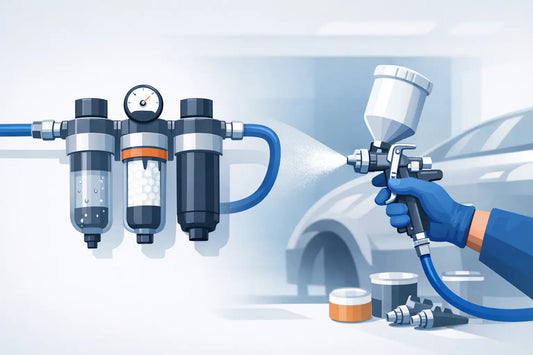
If your inflator performance is inconsistent, look upstream. Water in the line, pressure drops from undersized hose runs, or a regulator that creeps can all make tire service annoying. Even if you’re not running paint tools, clean and stable air improves day-to-day tasks, including tire inflation.
If you’re building out a pneumatic setup for real work, it’s worth getting your accessories squared away the same way you’d choose an impact or a grinder - based on uptime, not hype.
If you’re rotating tires, maintaining a family fleet, towing, or doing light shop work, prioritize a readable gauge, a dependable clip-on chuck, and a hose length that reaches without drama. If your work involves higher-volume tires or frequent checks, prioritize flow and durability. If you’re mainly chasing precise pressures for handling, MPG, or matching side-to-side, prioritize gauge readability and consistency.
For customers who want tools that show up fast and keep working, Pro Air Tools focuses on job-ready pneumatic gear with a 36-month warranty and 1-day shipping so a simple tool like an inflator doesn’t turn into a project-stopper.
The best tire inflator with pressure gauge is the one you’ll actually use every time - because it’s quick, accurate enough to trust, and built to take normal garage life without becoming another thing you have to babysit.
Factory direct from Le Lematec — professional quality, competitive prices.



 AIR REGULATORS

 ACCESSORIES