Shopping Cart
(0)
Free shipping included — no minimum on any US order

Quick Search:
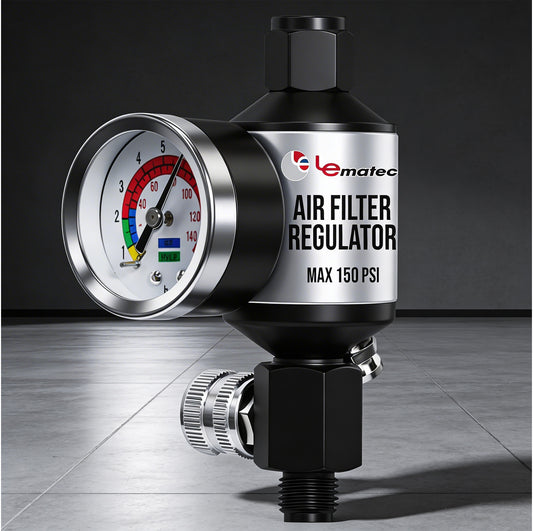





A tire that is 6 psi low does not look all that dramatic in the bay, but it can wear badly, handle poorly, and send you chasing a problem that is really just bad inflation. That is why any pneumatic tire inflator gauge review worth reading needs to focus on real shop performance, not just packaging claims.
If you use air tools regularly, you already know the pattern. Cheap inflators tend to fail in the same places. Gauges drift, chuck seals leak, hoses stiffen up, and the trigger starts feeling vague right when you need fine control. On paper, a lot of tire inflators look interchangeable. In practice, small differences in accuracy, build quality, and airflow control decide whether the tool saves time or wastes it.
The first thing to judge is accuracy, but accuracy alone is not enough. A gauge can be technically close and still be annoying to use if the dial is hard to read, the trigger overfills too easily, or the chuck does not stay seated on the valve stem. For automotive work, garage use, and maintenance tasks, the best inflator gauge is the one that gives repeatable pressure readings and lets you make quick corrections without fighting the tool.
Build quality comes next. A decent pneumatic tire inflator gauge should have a solid body, a hose that does not feel brittle, and fittings that stay tight under repeated use. Metal housings usually hold up better than lightweight plastic bodies, especially in shops where tools get dropped, dragged, and tossed back on a cart. That said, a heavier unit is not always better. If you are checking a full row of vehicles or moving around a service area, too much weight gets old fast.
The chuck style also matters more than some buyers expect. A clip-on chuck is useful when you want hands-free inflation, especially on larger tires or when you are adjusting multiple tires in sequence. A straight or push-on chuck can be quicker for simple pressure checks, but if the fit is loose, you lose air and accuracy at the same time. The best choice depends on how you work.
In any honest pneumatic tire inflator gauge review, inaccurate readings should remove a tool from consideration immediately. If you cannot trust the number, nothing else really matters. For passenger vehicles, being off by 1 to 2 psi may not sound major, but it adds up across four tires. On trailers, work trucks, or equipment with more demanding pressure requirements, that margin can become a real problem.
Analog gauges can still be excellent if the dial is clear and well-calibrated. Many techs prefer them because they are simple, quick to read, and not dependent on batteries. Digital gauges can offer easier readability and sometimes tighter resolution, but they introduce another failure point. A dead battery or moisture issue turns a useful tool into one more thing to troubleshoot.
For most buyers, repeatability is as important as raw precision. If the inflator gives the same reading every time on the same tire, you can work with confidence. If it jumps around, even by small amounts, it slows you down because you end up second-guessing every adjustment.
A tire inflator is not just a gauge with an air line attached. It is a control tool. The trigger should let you add air smoothly, not dump too much too quickly. That becomes especially important when you are topping off tires that are only a few psi low.
A good bleed valve matters just as much. Overinflation happens, even with experienced users, and a responsive bleed function lets you correct pressure without disconnecting and starting over. On lower-end models, the bleed can feel delayed or inconsistent. That does not just waste a few seconds. It creates frustration every time you use it.
This is one of those areas where specs do not tell the full story. Two inflators may list similar pressure ranges and hose lengths, but one will feel controlled and predictable while the other feels jumpy. If a tool is going to live in a working garage, trigger feel is not a minor detail.
A stiff, short hose is one of the fastest ways to make a tire inflator annoying. You should be able to reach the valve stem comfortably without forcing the angle and stressing the connection. A little flexibility goes a long way, especially on tighter wheel designs or recessed stems.
Swivel fittings help more than many buyers realize. Without them, the hose tends to twist while you work, which pulls on the chuck and makes leaks more likely. If you are servicing multiple vehicles a week, that constant fighting adds up.
Chuck fit should be firm, quick, and low-drama. If it takes too much pressure to seat properly, you lose efficiency. If it slips off too easily, you lose air and confidence. For buyers comparing models, this is one of the most practical differences between budget inflators and better shop-grade units.
A lot of inflators are good enough for a glove box or home compressor setup that gets used once a month. That is not the same standard as a tool used in a shop, a fabrication space, or a busy home garage. If the inflator sees regular duty, seals, hose quality, trigger assembly, and gauge protection all become more important.
Rubber gauge guards are worth having if the tool is likely to get dropped. Reinforced hoses tend to hold up better than very soft, lightweight lines that kink early. Threaded connections should feel tight and properly finished, not like they were assembled as an afterthought.
There is always a price trade-off here. Entry-level inflators can work fine for occasional use. But if downtime matters, replacing a failed inflator is rarely as cheap as it first looks. The better value is usually the model that survives regular use without needing constant attention.
This part of a pneumatic tire inflator gauge review usually gets oversimplified. Neither analog nor digital is automatically better. It depends on your environment and what you expect from the tool.
Analog inflators make sense for users who want simplicity, no batteries, and easy service-bay reliability. They are often a better fit in rougher workspaces where electronics can take more abuse. If the dial is large and protected, an analog unit can be very efficient.
Digital inflators make more sense if quick readability is your priority, especially in lower light or when you need more exact visual confirmation. Some users simply prefer seeing a clear numerical readout. The trade-off is that digital models can be less forgiving when exposed to impact, moisture, or dead batteries at the wrong time.
For most working buyers, the question is not which type sounds more advanced. It is which one stays dependable in your setup.
If you are a casual DIY user topping off family vehicles, you probably do not need the heaviest-duty inflator on the market. A solid analog model with reliable accuracy, decent hose flexibility, and a secure chuck will usually cover the job well.
If you are a small-shop mechanic, maintenance buyer, or serious hobbyist using compressed air every week, it makes sense to step up into a more durable unit. Better hose materials, tighter gauge consistency, and stronger chuck construction pay off quickly when the tool is in regular rotation.
If speed matters because vehicles need to move and work cannot stop, buy for uptime, not just price. That is where warranty coverage and fast fulfillment become part of the value. A supplier like Pro Air Tools makes more sense in that situation because buyers are not just purchasing a tool. They are reducing the risk of delays.
The best inflator gauge is not the one with the longest feature list. It is the one that reads accurately, controls airflow cleanly, fits the valve without fuss, and keeps doing that after repeated use. If a model gets those basics right, it earns space in the shop. If it misses even one of them, you will notice every time you reach for it.
Buy the inflator that matches your workload, not your wish list. A dependable tool that ships fast and holds up under pressure is worth more than a bargain that turns tire service into trial and error.





 AIR REGULATORS

 ACCESSORIES