


 AIR REGULATORS

 ACCESSORIES
Air Compressor Fittings: Types, Sizes & Compatibility Guide (2026)
Choosing the right air compressor fittings is one of the most overlooked steps in setting up a compressed air system—yet it directly affects airflow, pressure consistency, and whether your tools perform at their best. A mismatched fitting can slash CFM delivery, cause persistent leaks, and even damage expensive pneumatic equipment.
This guide covers every fitting type you’ll encounter, standard sizing conventions, thread compatibility, and how to build a leak-free air system from compressor to tool.
Why Air Compressor Fittings Matter More Than You Think
Every connection in a compressed air line is a potential failure point. The average shop loses 20–30% of its compressed air to leaks—and fittings are the #1 culprit. Beyond leaks, the wrong fitting can create turbulence that reduces effective CFM at the tool, meaning your air tools won’t reach their rated CFM and PSI.
Proper fittings ensure three things: a secure, airtight seal; unrestricted airflow to maintain pressure; and quick, safe tool changes when you need them.
Common Air Compressor Fitting Types
Quick-Connect Couplers and Plugs
Quick-connect (or quick-disconnect) fittings are the workhorses of any pneumatic setup. They let you swap tools in seconds without shutting down the compressor. A coupler (female) stays on the hose, while a plug (male) attaches to each tool. When you push the plug into the coupler, an internal valve opens and air flows; pull back the collar and the valve seals automatically.
Quick-connects come in several profiles. The most common in North America is the Industrial (I/M) style, sometimes called “Milton” style. The Automotive (T) style has a slightly different internal geometry. These profiles are not interchangeable—an I/M plug won’t seat properly in a T coupler, even if the thread size matches. Always verify the profile before buying replacements.
Pro Air Tools’ 15-Piece Air Compressor Fittings & Hose Kit includes Industrial-profile couplers and plugs in 1/4″ NPT, covering the most common configuration for home and professional shops.
Push-to-Connect (Push-In) Fittings
Push-to-connect fittings use an internal collet and O-ring to grab tubing when you push it in. They’re popular in automated systems and bench-top setups where vibration is minimal. To disconnect, press the release ring and pull the tube out. These work best with nylon or polyurethane tubing and are rated for lower pressures than threaded fittings (typically up to 150 PSI).
Compression Fittings
Compression fittings use a nut and ferrule (olive) to create a seal around copper or nylon tubing. They’re common in permanent plumbing-style air lines that run along shop walls. The ferrule deforms against the tube when the nut is tightened, creating a strong mechanical seal that can handle high pressures and vibration. The trade-off is that they’re slower to install and effectively permanent—once a ferrule is compressed, it can’t be reused.
Barbed (Hose Barb) Fittings
Barbed fittings have ridged ends that grip the inside of flexible hose. They’re secured with hose clamps and are the simplest, cheapest option for connecting rubber or PVC air hose. While they work for low-pressure applications, barbed fittings are more prone to leaks under high pressure or temperature changes compared to threaded or quick-connect options.
Threaded Pipe Fittings (NPT and BSP)
Threaded fittings are the foundation of compressed air plumbing. In North America, the standard is NPT (National Pipe Taper)—a tapered thread that creates a seal as it tightens. In Europe and Asia, BSP (British Standard Pipe) threads are standard. NPT and BSP threads have different angles (60° vs. 55°) and are not compatible, even when diameters appear to match.
Common NPT sizes for air compressor fittings include 1/4″ NPT (the most common for air tools and hose connections), 3/8″ NPT (for higher-CFM tools and longer runs), and 1/2″ NPT (for main trunk lines and large compressors).
Always apply PTFE thread tape (Teflon tape) on NPT connections. Wrap 3–5 turns clockwise (facing the end of the fitting) before threading together. This fills micro-gaps in the tapered threads and prevents air leaks.
Understanding Fitting Sizes
Fitting sizes in the pneumatic world can be confusing because the nominal size (e.g., “1/4 inch”) doesn’t match the actual measured diameter. A 1/4″ NPT fitting has an outside thread diameter of approximately 0.540″. This is a legacy naming convention from iron pipe standards.
Here’s a quick reference for the most common sizes:
- 1/4″ NPT — OD ~0.540″. Standard for most air tools, regulators, and hose ends. Adequate for tools requiring up to ~12 CFM.
- 3/8″ NPT — OD ~0.675″. Better for high-demand tools like sandblasters and impact wrenches. Reduces pressure drop over longer distances.
- 1/2″ NPT — OD ~0.840″. Used for main lines, manifolds, and high-CFM applications above 15 CFM.
The rule of thumb: never reduce fitting size between the compressor and the tool. A 3/8″ hose connected through a 1/4″ fitting creates a bottleneck that chokes airflow. If anything, go larger—you can always reduce at the final tool connection without significant loss.
How to Choose the Right Fittings for Your Setup
Match Fittings to Your Tools’ CFM Requirements
Before choosing fittings, determine the CFM requirements of your tools. A finish nailer pulling 2 CFM runs fine through 1/4″ fittings. A sandblaster requiring 8–12 CFM needs 3/8″ fittings and hose to avoid starving the gun. Check our pneumatic tool CFM & PSI requirements chart for specific numbers.
Consider Hose Length and Diameter
Pressure drops increase with distance. For runs under 25 feet, 1/4″ fittings with a 3/8″ hose work well for most tools. For runs over 50 feet, upgrade to 3/8″ fittings throughout. Read our air hose size guide for detailed sizing recommendations based on length and CFM.
Standardize on One Quick-Connect Profile
Mixing Industrial and Automotive quick-connects in the same shop leads to frustration. Pick one profile and stick with it across all your tools, reels, and manifolds. Industrial (I/M) is the most common and offers the widest selection of accessories.
Account for Inline Accessories
Every inline device—filter, regulator, lubricator, manifold—adds a connection point. Use the same size or larger fittings for these components. An FRL (Filter-Regulator-Lubricator) system typically connects with 1/4″ or 3/8″ NPT depending on your airflow needs.
How to Fix and Prevent Air Compressor Fitting Leaks
Air leaks at fittings are the most common compressed air problem. Here’s a systematic approach to finding and fixing them.
Finding Leaks
The soapy water test is simple and effective: mix dish soap with water in a spray bottle, pressurize the system, and spray every fitting. Bubbles indicate a leak. For larger systems, an ultrasonic leak detector can find leaks you can’t reach with a spray bottle. Learn more in our air hose connectors and fittings installation guide.
Common Leak Causes and Fixes
Missing or worn thread tape: Remove the fitting, clean the threads, apply fresh PTFE tape (3–5 wraps clockwise), and reinstall. Don’t over-tighten—NPT fittings seal through taper, not brute force.
Cross-threaded connections: If a fitting feels like it’s binding, back it out and start again. Cross-threading damages both the fitting and the port, sometimes requiring replacement of the receiving component.
Worn quick-connect seals: Quick-connect couplers have internal O-rings that wear over time. If a coupler leaks around the plug, replace the O-ring or the entire coupler—they’re inexpensive and not worth troubleshooting.
Cracked or corroded fittings: Brass fittings can develop stress cracks, especially if over-tightened. Steel fittings can corrode internally. If a fitting shows visible damage, replace it immediately.
Fitting Materials: Brass vs. Steel vs. Composite
Brass is the most popular material for air compressor fittings. It resists corrosion, machines easily to precise tolerances, and doesn’t spark (important in environments with flammable vapors). Most quality quick-connects and NPT fittings are brass.
Ready to put this into practice?
15-Piece Air Compressor Fittings Kit
Everything in this guide — 1/4" NPT quick-connects, plugs, couplers — in one ready-to-ship kit.
Shop the Fittings Kit →Steel fittings are stronger and handle higher pressures, but they’re heavier and can rust if the plating wears off. Galvanized steel is common for permanent pipe installations. Stainless steel offers the best of both worlds but at a premium price.
Composite/Plastic fittings are lightweight and affordable but typically rated for lower pressures. They’re fine for drain valves and low-pressure applications but shouldn’t be used for main air lines.
Building a Complete Fitting Kit
Rather than buying individual fittings as you need them, a comprehensive kit saves time and ensures compatibility. A good starter kit should include: multiple quick-connect couplers and plugs (at least 2 couplers and 4–6 plugs), NPT adapters in common sizes (1/4″ to 3/8″ reducers), PTFE thread tape, a hose repair fitting, and a blowgun attachment.
The Pro Air Tools 15-Piece Fittings & Hose Kit covers all these bases with Industrial-profile quick-connects and a 25-foot hybrid hose, giving you everything needed to go from compressor to tool in one box.
Quick pick: pair the kit with these
Once your fittings are sorted, the next leak-and-CFM bottleneck is usually air conditioning. Two compact options that share the same 1/4" NPT footprint as the kit:
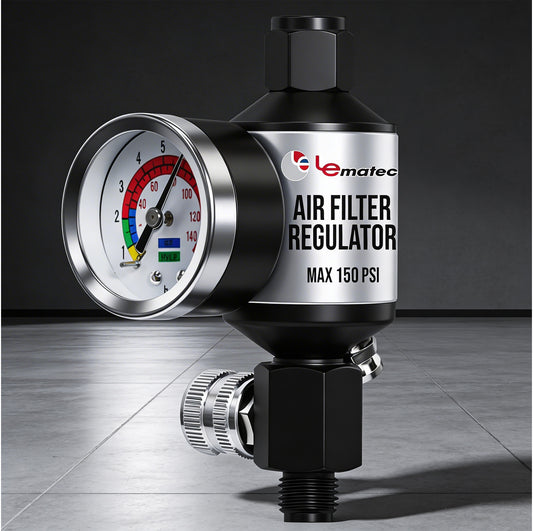
- AI303-R1 Filter Regulator with Gauge — 140 PSI, 1/4" NPT all-in-one filter + regulator + gauge for small shops.
- DAR01B Digital Air Regulator — if you want a precise digital readout instead of an analog gauge for spray painting or CNC work.
- 2-in-1 Vacuum & Blower Kit — turns your compressor into a shop vacuum using the same 1/4" NPT fittings.
Adapter Fittings for Cross-Compatibility
Sometimes you inherit tools with different fitting profiles, or you buy an import with BSP threads. Adapter fittings solve these problems without replacing the entire connection. Common adapters include NPT-to-BSP thread adapters, Industrial-to-Automotive coupler adapters, male-to-male and female-to-female NPT unions, and reducer bushings (e.g., 3/8″ to 1/4″ NPT).
Every adapter adds a potential leak point and a small pressure drop, so use them judiciously. If you find yourself using the same adapter repeatedly, it’s better to replace the underlying fitting with the correct size.
Air Compressor Fitting Maintenance Tips
Fittings are low-maintenance but not zero-maintenance. Inspect quick-connect seals quarterly—look for cracking or flattening of O-rings. Apply a drop of pneumatic oil to quick-connect mechanisms every few months to keep the sleeve action smooth. Re-tighten threaded connections annually, especially on systems that experience temperature swings or vibration from nearby machinery. Replace any fitting that shows visible corrosion, cracking, or persistent leaking after re-taping.
For complete compressed air system maintenance, pair proper fittings with a quality inline air filter and pressure regulator to protect your tools and maintain consistent performance.
Frequently Asked Questions
What size fittings do most air compressors use?
Most portable and mid-size air compressors use 1/4-inch NPT fittings for output connections. Larger shop compressors (5+ HP) often use 3/8-inch or 1/2-inch NPT. The fittings on the compressor outlet, hose, and tool inlet should all match or step down only at the final tool connection to avoid restricting airflow.
Are all air compressor quick-connect fittings interchangeable?
No. Quick-connect fittings come in different profiles (Industrial/I-M, Automotive/T, ARO, and others) that are not cross-compatible. A plug from one profile will not properly seat or seal in a coupler from a different profile, even if the NPT thread size is the same. Standardize on one profile throughout your shop to avoid connection issues.
Why do my air compressor fittings keep leaking?
The most common causes of leaking air fittings are: missing or improperly applied PTFE thread tape on NPT connections, worn O-rings in quick-connect couplers, cross-threaded connections that damage the seal, and over-tightened fittings that crack the brass. Apply 3–5 wraps of PTFE tape clockwise before threading NPT fittings, and replace quick-connect O-rings when they show wear.
Can I use NPT fittings with BSP threads?
NPT (National Pipe Taper) and BSP (British Standard Pipe) threads are not directly compatible. NPT uses a 60-degree thread angle while BSP uses 55 degrees, and the thread pitches differ. While they may appear to thread together in some sizes, the connection will not seal properly and will leak under pressure. Use a proper NPT-to-BSP adapter fitting for cross-standard connections.
What is the best material for air compressor fittings?
Brass is the best all-around material for air compressor fittings. It resists corrosion from moisture in compressed air, machines to precise tolerances for reliable seals, and does not create sparks. Steel fittings are stronger for high-pressure permanent installations, while composite fittings are suitable for light-duty or low-pressure applications only.
Tags:
Related articles
High Torque Impact Wrench: How Much Is Enough?
Jun 03 2026
Choosing Air Hose for Shop Layout
Jun 01 2026

How to Set Air Regulator Pressure Right
May 30 2026
Air Filter Water Separator Installation Tips
May 28 2026
Guide to Shop Air Line Layout That Works
May 26 2026
Air Ratchet vs Electric Ratchet
May 24 2026