Shopping Cart
(0)
Free shipping included — no minimum on any US order

Quick Search:



A lot of air tool problems get blamed on the compressor when the real issue is the hose run. If you're choosing air hose for shop layout, the wrong inside diameter, the wrong material, or a few bad routing decisions can leave an impact wrench weak, a grinder inconsistent, and a blast cabinet frustrating to use.
A good layout does not need to be fancy. It needs to deliver enough air, hold up to daily abuse, and stay out of your way. That means matching hose size and material to the tools you actually run, then planning the route around pressure drop, movement, and future expansion.
Compressed air systems are only as strong as the narrowest, weakest part of the line. You can have a capable compressor and still get poor results if the hose is too small, too long, or too restrictive at the couplers. This shows up fast on high-demand tools like grinders, sanders, cutoff tools, and sandblasting equipment.
The main issue is pressure drop. Every foot of hose, every fitting, every quick coupler, and every sharp bend adds resistance. A short undersized hose might still work for airing up tires, but once you run tools continuously, airflow becomes the deciding factor. That is why hose selection is not just about reaching the workbench. It is about maintaining tool performance under load.
If your shop handles different jobs, it also helps to think in zones. A bench area, a lift bay, and a blast corner do not always need the same hose setup. The best layout is usually a main distribution plan with hose choices matched to each work area instead of one size used everywhere.
The fastest way to make the right choice is to work backward from your highest air demand. Look at the tools that will run the longest or pull the most CFM. In many small shops, that is a die grinder, dual-action sander, blast gun, or other continuous-use tool. Intermittent tools like ratchets and impact wrenches still matter, but they usually punish the system less.
Check three things before you buy hose. First is the tool's required CFM at working pressure. Second is how long the hose run will actually be from the air source to the tool. Third is whether that hose will be fixed in place, dragged around the floor, or reeled overhead.
This is where people often undersize. A 1/4-inch hose can be fine for short runs and lighter tools, but it becomes a bottleneck fast when the run gets longer or the tool demands steady volume. A 3/8-inch hose is the more forgiving choice for many general shop setups because it supports better flow with less pressure loss. For heavy-demand stations or longer permanent runs, stepping up further may make sense.
When people talk about air hose, they often focus on hose length or material first. Inside diameter deserves more attention because it directly affects flow. If you are choosing air hose for shop layout, this one spec often matters more than the brand name on the carton.
For lighter-duty tasks, a 1/4-inch ID hose can work well and stays easier to handle. It is a common pick for inflators, blow guns, and some intermittent tools. But in a working shop, especially one running automotive or fabrication tools, 3/8-inch ID is often the better baseline. It gives more volume to the tool and reduces the odds that the hose is choking performance.
If you are feeding a dedicated station with higher CFM demand, larger line sizes upstream make sense even if the whip hose at the tool is smaller. That setup can keep the system efficient without forcing the operator to wrestle a heavy hose at the point of use.
The trade-off is simple. Larger hose improves airflow, but it is heavier, stiffer, and usually costs more. Smaller hose is lighter and easier to manage, but it can starve tools. The right answer depends on the tool mix and the run length, not just convenience.
Rubber, PVC, polyurethane, and hybrid hoses all have their place. The best choice depends on how the hose will be used every day.
Rubber hose is tough, flexible, and a strong fit for busy shops. It handles abuse well and stays manageable in a wide range of temperatures. If a hose will be dragged around concrete, pulled under vehicles, or used hard every week, rubber is a dependable option.
PVC hose is usually the budget-friendly choice, but it tends to be stiffer and less cooperative, especially in colder conditions. It can still make sense for lighter use or stationary setups where cost matters most, but it is usually not the first choice for a hose that gets handled all day.
Polyurethane hose is lighter and often easier to move, which can be useful for detail work or mobile use. The downside is that it may not feel as rugged in harsh shop conditions, depending on the specific product.
Hybrid hoses try to split the difference. They are often more flexible than PVC and lighter than traditional rubber. For a lot of general-purpose shop use, that balance is attractive.
The practical question is not which material sounds best on paper. It is whether the hose stays flexible, resists kinking, and holds up where you actually work.
A smart shop layout reduces both frustration and air loss. Long snaking hose runs across the floor are bad for flow and bad for safety. If possible, keep the main distribution close to where high-demand tools are used most often.
Overhead reels are a strong option when you need mobility without floor clutter. They keep hose out of traffic and shorten the amount of hose that stays stretched across the work area. Wall-mounted reels can work just as well in tighter spaces where a single bench or bay handles most tasks.
For fixed stations, use larger supply lines and keep the flexible working hose as short as practical. This gives you better airflow while keeping the tool end easier to handle. It also helps to avoid unnecessary elbows, reducers, and bargain-bin couplers that restrict flow more than expected.
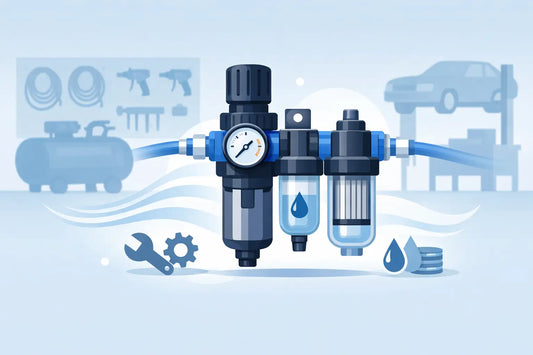
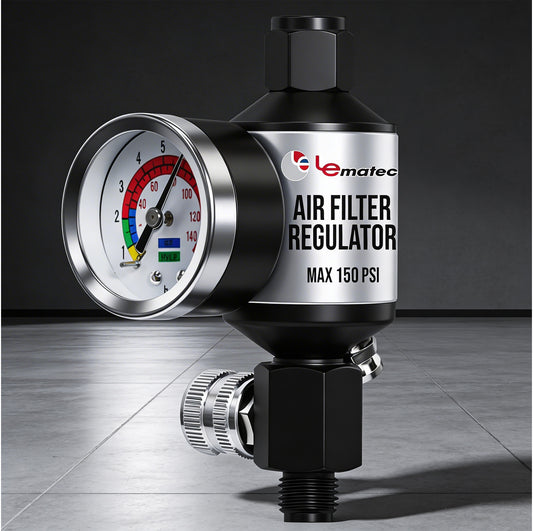
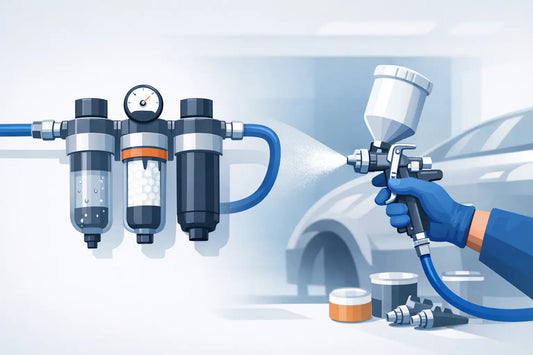
Drainage and air treatment matter too. If part of your layout includes paint prep, blasting, or moisture-sensitive tools, place filters and regulators where they support the station without creating needless hose length after the treatment point. The layout should serve both airflow and air quality.
A lot of shops upgrade hose and still see weak performance because the fittings remain undersized. A high-flow hose feeding a restrictive coupler is still a restrictive system. This is especially noticeable on tools with steady demand.
Match fittings to the hose ID and the tool demand. If your main working hose is 3/8-inch, make sure the couplers and fittings are not quietly bringing you back down to a smaller effective opening. The same logic applies to regulators and filter setups. A cheap component placed in the wrong spot can waste the benefit of a good hose plan.
This is also where buying for reliability matters. Hose, fittings, and accessories are not the place to gamble on parts that fail early or create downtime. Fast fulfillment and a real warranty matter more when the system is part of your daily workflow, which is one reason many buyers stick with a supplier like Pro Air Tools.
If your shop is general automotive, maintenance, or fabrication work, a 3/8-inch ID hose is often the safest starting point for your main working line. Pair that with durable hose material and quality couplers, then keep the run as short and direct as the space allows.
If you mostly use lighter intermittent tools and want maximum flexibility, a 1/4-inch hose may still do the job, especially on short runs. Just be honest about future use. If you already know a grinder, sander, or blast setup is part of the plan, buying too small now usually means buying twice.
For fixed work zones, think in layers. Use adequately sized supply lines to feed the station, then use a shorter flexible hose where the operator needs movement. For mobile work, prioritize hose material and reel setup so the hose is easy to manage and less likely to kink or become a trip hazard.
The best shop hose layout is the one that disappears into the background. Your tools hit hard, the hose does not fight you, and the system keeps up when the work gets real. If you plan around airflow first and convenience second, you usually end up with both.


 AIR REGULATORS

 ACCESSORIES