Shopping Cart
(0)
Free shipping included — no minimum on any US order

Quick Search:

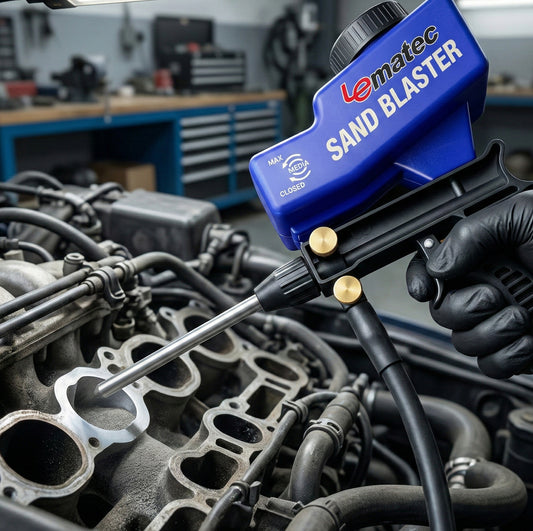
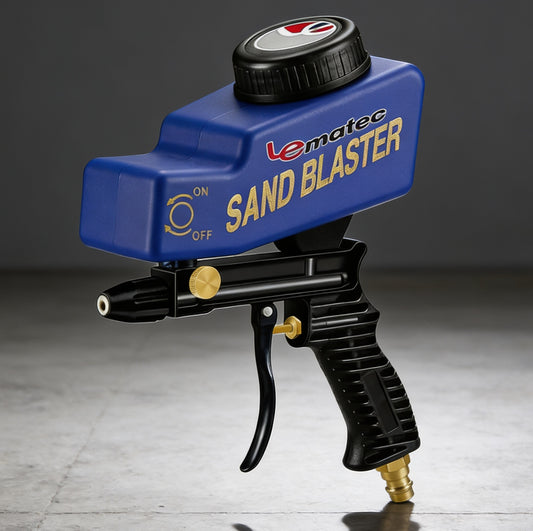
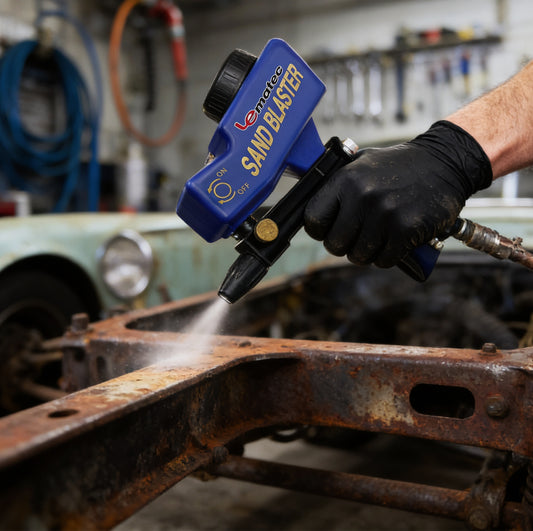
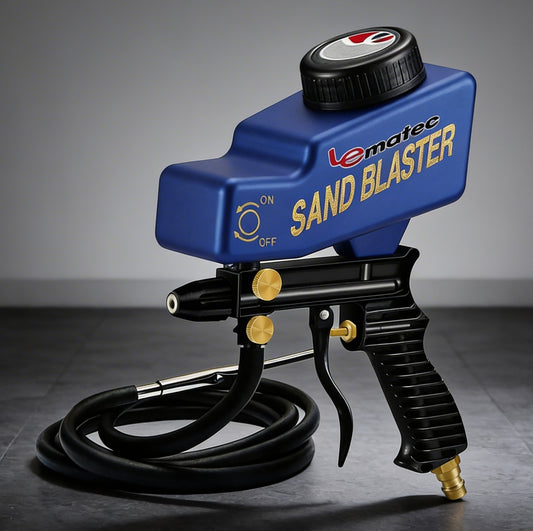
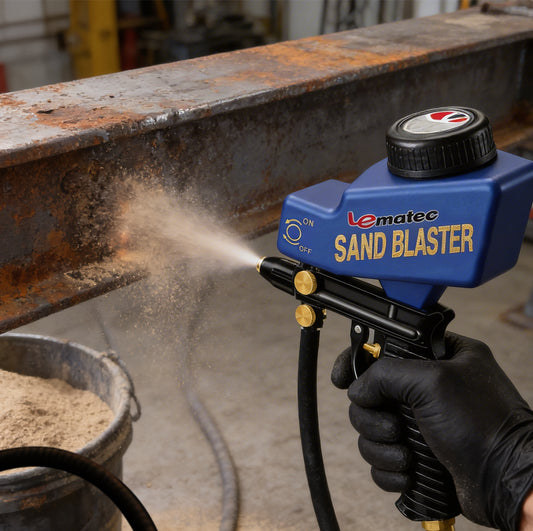
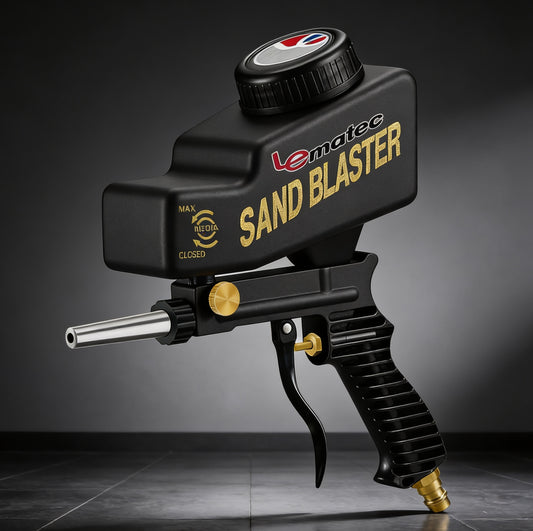
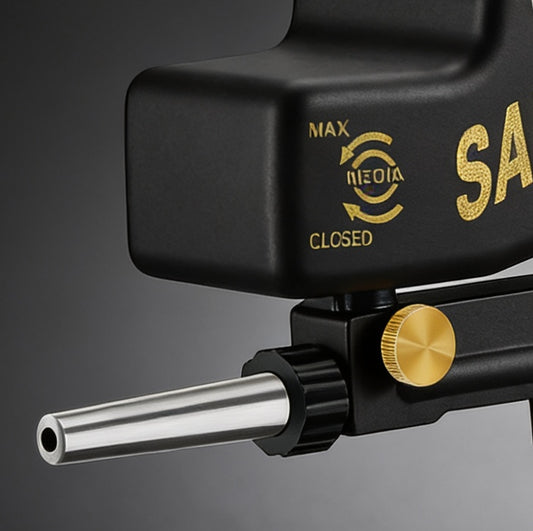

Sandblasting with regular silica sand is dangerous and should not be done. It releases respirable crystalline silica dust, which causes silicosis — a serious, progressive, and incurable lung disease. The U.S. Occupational Safety and Health Administration (OSHA), the National Institute for Occupational Safety and Health (NIOSH), and the Centers for Disease Control and Prevention (CDC) all warn against using silica sand for blasting, and most commercial blasters worldwide have switched to silica-free media.
If you're new to sandblasting, this is the most important thing to learn before you start. The good news: there are excellent silica-free alternatives that cut as well or better than sand, and using them is the difference between sandblasting being a useful skill versus a long-term health risk.
Looking for a complete kit? Browse all Pro Air Tools bundles — save 8% on curated sandblasting, hookup, and detailing kits.
Silicosis is a lung disease caused by inhaling fine particles of crystalline silica — the kind of dust released when you blast with sand, grind concrete, or cut natural stone without dust control. Once inhaled, silica particles lodge permanently in the lungs and cause inflammation, scarring (fibrosis), and progressive loss of breathing capacity.
There is no cure. The damage is irreversible. The only treatment is supportive — oxygen therapy, anti-inflammatory medication, eventually lung transplant in advanced cases.
Silicosis develops over years to decades of exposure, but the dust concentrations from sandblasting are high enough that even short-term exposure can cause acute silicosis, a faster-progressing form that can develop within months. Workers exposed to high silica concentrations have died within a few years of first exposure.
For a deeper read, the CDC's NIOSH silica page covers the science.
OSHA's silica standard (29 CFR 1926.1153 for construction, 1910.1053 for general industry) sets a permissible exposure limit of 50 micrograms per cubic meter of air, averaged over an 8-hour shift. Sandblasting with silica sand produces dust concentrations that exceed this limit by orders of magnitude — even with respiratory protection in a controlled environment.
NIOSH's recommendation goes further: stop using silica sand as a blasting abrasive entirely. Their official position, summarized in NIOSH Alert 92-102, is that silica sand should be replaced with safer alternatives in all blasting operations. The NIOSH Alert specifically warns that silicosis cases continue to occur in sandblasters despite respiratory protection because the protection is imperfect, fails, or is improperly used.
In practical terms: even with the right PPE, sandblasting with sand is a meaningful health risk. Without the right PPE, it's life-threatening.
Several countries have effectively banned silica sand for blasting in commercial settings. The U.S. has not implemented an outright ban, but OSHA enforcement and NIOSH guidance have pushed most professional blasters to silica-free alternatives.
The good news: silica-free abrasives are widely available, often cheaper per unit of work, and frequently cut better than sand. The right choice depends on what you're trying to do.
A synthetic abrasive made from silicon dioxide + carbon fused at extreme temperature. Hard, sharp-edged, fast-cutting. Best for steel, cast iron, aluminum, and other hard surfaces — paint stripping, rust removal, metal preparation for powder coating or paint. Common grits range from 36 (coarse, aggressive) to 220 (fine, surface prep).
Pro Air Tools' Silicon Carbide 60-grit media is the general-purpose silicon carbide option for most DIY and shop applications.
Yes, baking soda. Industrial-grade sodium bicarbonate is much softer than mineral abrasives and water-soluble. Gentle, non-destructive, washes away with water. Best for delicate surfaces — wood furniture restoration, brick masonry cleaning, glass etching, engine block degreasing, motorcycle frame cleaning where chrome or aluminum trim must not be damaged.
Soda blasting is the standard choice for graffiti removal from historic buildings because it doesn't pit the underlying surface. Pro Air Tools' Soda Blasting Media is food-grade sodium bicarbonate.
Similar profile to silicon carbide — synthetic, hard, fast-cutting. Slightly tougher (lasts longer per pass) but slightly less sharp. Common in commercial blast cabinets.
A natural mineral abrasive that's silica-free. Medium-aggressive cutting, often used in commercial blasting and waterjet cutting. Lower-cost than silicon carbide but produces more dust per unit of work.
Crushed walnut shells are extremely soft. Best for engine cleaning, antique restoration, and any application where damage to the substrate must be zero. Don't expect them to cut paint or rust.
Spherical glass particles. Used for peening (work-hardening a surface) and polishing rather than cutting. Best for finishing already-clean surfaces — cosmetic refinish of metal parts.
Some products marketed for blasting still contain silica. Common offenders:
Always check the Safety Data Sheet (SDS) before using any abrasive. The SDS lists the chemical composition; look for entries like "crystalline silica," "silicon dioxide (crystalline)," or "quartz." If those appear, the abrasive contains silica and should not be used for blasting.
All abrasives sold through Pro Air Tools' sandblasting media collection are silica-free.
If you've used silica sand in the past — even just once — talk to a doctor. Mention silica exposure specifically. Silicosis can develop years after exposure, and early detection allows for monitoring and management.
For ongoing protection going forward:
Silica sand was the standard blasting abrasive for most of the 20th century. We now know it shouldn't have been. The shift to silica-free abrasives is not a nice-to-have for sandblasters — it's a baseline safety requirement that OSHA, NIOSH, and the CDC all support.
The good news: silicon carbide, soda, aluminum oxide, garnet, walnut shells, and glass beads cover essentially every blasting use case. The right one for your job depends on the substrate and the desired finish, not on whether you're willing to accept the silica risk.
Often, yes. Most natural sand — including beach sand, riverbed sand, and play sand — contains significant crystalline silica from quartz weathering. Some specialty sands are marketed as low-silica, but the safe default is to assume natural sand contains silica unless explicitly tested otherwise.
No. NIOSH has documented silicosis cases in workers using full respiratory protection. Respirators reduce exposure but do not eliminate it. The only fully safe approach is to switch to a silica-free abrasive.
Usually no. Common bottle and window glass contain 60-75% silica. Specialty crushed-glass blast abrasives may be silica-free if specifically formulated, but check the SDS to confirm.
Silicon carbide (SiC) is a synthetic compound of silicon and carbon. It is chemically distinct from crystalline silica (silicon dioxide, SiO2), which is the harmful compound. Silicon carbide does not produce silica dust when blasted.
Both are silica-free and meet safety guidelines. Soda is softer and produces less rebound, which can be safer in tight workspaces. Silicon carbide cuts faster but produces more rebounding particles. Either is significantly safer than silica sand.
You still need ventilation and a NIOSH-rated respirator — silica-free media still produces airborne particles and dust at high concentrations, just without the silicosis risk. Use a blast cabinet or work in a well-ventilated area, and always wear appropriate PPE.
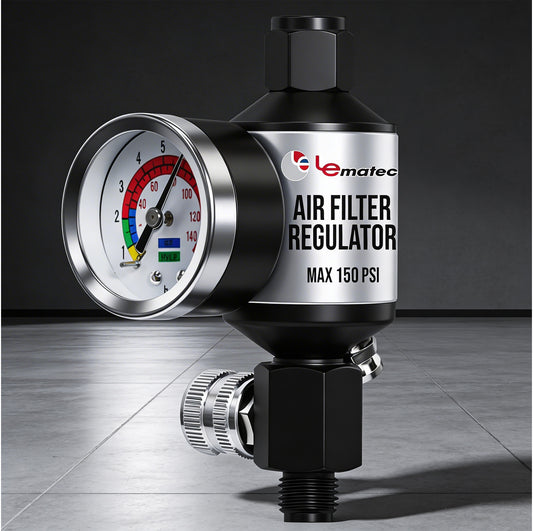
Looking for silica-free sandblasting media? Browse our sandblasting media collection, or grab everything you need to get started in the Sandblasting Starter Kit — sandblaster, silica-free media, regulator, and air connector at a bundle price.


 AIR REGULATORS

 ACCESSORIES