Shopping Cart
(0)
Free shipping included — no minimum on any US order

Quick Search:



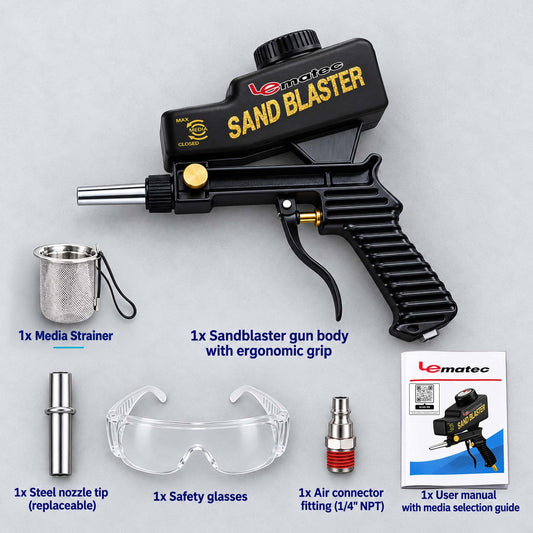

A blast pot can be full, the compressor can be running, and the nozzle can still feel weak. Often, the restriction is not the compressor. It is the hose between the media valve and the nozzle. Choosing the correct sandblaster hose size for media flow keeps abrasive moving at a usable rate, protects working pressure, and prevents the stop-and-start blasting that turns a short prep job into an all-day problem.
Hose size is not a cosmetic spec. A hose that is too small for the nozzle and abrasive mix creates pressure loss, uneven media delivery, and premature hose wear. A hose that is larger than the setup needs can cost more, weigh more, and be less convenient to manage. The right choice is the one that matches the blasting method, nozzle, media, hose length, and available compressor output.
Sandblasting hose carries a high-speed mix of compressed air and abrasive. That mix needs room to travel. When the inside diameter is too tight, the air and media are forced through a restriction before they reach the nozzle. Pressure drops, media flow becomes inconsistent, and the nozzle cannot produce the cleaning speed it was selected for.
The difference is easy to recognize in the field. A properly sized line delivers a steady blast pattern and a consistent sound at the nozzle. An undersized line may surge, pulse, or seem to run out of cutting power when the trigger is held. Operators often respond by opening the media valve farther. That usually makes the problem worse because it adds more abrasive to a line that is already restricted.
Do not confuse hose outside diameter with hose size. The number that matters for flow is the hose's inside diameter, commonly listed as ID. Also check the actual bore of couplings, reducers, ball valves, and fittings. A 1-inch hose does not perform like a 1-inch hose if a narrow fitting in the middle reduces the passage.
A practical starting point is to use blast hose with an inside diameter about three to four times the nozzle orifice diameter. This gives the air and abrasive stream enough space to reach the nozzle without unnecessary restriction.
| Nozzle orifice | Common blast hose ID | Typical use |
|---|---:|---|
| 1/8 inch | 1/2 inch | Detail work, small cabinets, light spot blasting |
| 3/16 inch | 3/4 inch | General restoration and smaller pressure-pot work |
| 1/4 inch | 1 inch | Productive automotive, fabrication, and maintenance blasting |
| 5/16 inch | 1-1/4 inch | Higher-output production work with adequate compressor capacity |
These are working guidelines, not a substitute for the recommendations supplied with your blast pot and nozzle. A long run, heavy media, or a high-output nozzle may justify moving up one hose size. On the other hand, a compact blasting cabinet or a small suction system may operate well with a smaller line because its media demand is lower.
The nozzle is the final restriction in the system, and it largely determines air consumption. Moving from a 3/16-inch nozzle to a 1/4-inch nozzle is not a small change. It increases the area of the opening substantially, which raises CFM demand and increases the amount of media the system can move. If the hose, fittings, compressor, or moisture control cannot support that change, the larger nozzle will not deliver its expected production gain.
A short hose can tolerate a tighter setup better than a long one. Every additional foot adds friction and gives pressure more opportunity to drop before it reaches the nozzle. If your pot is parked close to the work and the blast hose is 15 to 25 feet long, the standard sizing guidance is usually a strong fit.
For 50-foot or 100-foot hose runs, pay closer attention. Long runs often perform better with the next larger hose ID, especially when using angular abrasive, larger nozzle orifices, or pressure above 90 PSI. The same rule applies to air supply hose from the compressor to the pot. A restrictive air line can starve the pot even when the blast hose itself is correctly sized.
Keep the hose route as straight as the job allows. Sharp bends, pinched sections under tires, and repeated tight coils all reduce effective flow. They also wear the hose faster where abrasive impacts the inside wall.
Media shape, density, and grain size all affect how freely it moves. Fine glass bead and fine aluminum oxide can often travel through smaller systems more easily than coarse slag or aggressive steel grit. But free-flowing media is only part of the equation. The nozzle and compressor still set the ceiling for how much blasting work the system can do.
Coarse or angular media deserves extra attention. It is more likely to bridge at the metering valve, pack into a restriction, or wear out undersized fittings. If you are stripping heavy rust, scale, or old coatings with a larger abrasive, avoid building the media path around small adapters. Use media-rated hose, full-bore fittings, and a hose ID appropriate for the nozzle.
Moisture creates another kind of restriction. Wet air can make abrasive clump before it even reaches the blast hose. If the media surges and the hose is properly sized, inspect the air supply before replacing parts. A properly placed moisture separator, filter, and dry media can solve a problem that looks like a flow issue.
A pressure pot pushes pressurized media into the blast stream. It is the better choice when you need faster cleaning, more consistent media delivery, or the ability to run a larger nozzle. Because a pressure pot moves more material, hose size matters more. Restricting the line can waste the advantage you paid for.
A siphon-feed blaster uses airflow to draw media from a pickup tube. These systems are generally less demanding, but they are also more sensitive to air leaks and pickup restrictions. The media hose may be smaller than pressure-blast hose, depending on the gun design. Do not enlarge components at random. Match replacements to the gun's inlet, pickup tube, and nozzle system so the vacuum signal remains effective.
For either style, use hose built for abrasive service. Standard air hose may appear similar from the outside, but it is not designed for the internal wear caused by blasting media. Abrasion-rated blast hose lasts longer, maintains its bore better, and makes replacement intervals more predictable.
When a blasting setup lacks power, start at the compressor and work toward the nozzle. Confirm that compressor delivered CFM meets the nozzle requirement at your actual working pressure, not just at peak rating. Then check the regulator, water separator, air supply hose, blast pot valve, media metering valve, blast hose, couplings, and nozzle.
A worn nozzle is easy to overlook. As the orifice wears larger, it consumes more air. Your compressor may have kept up when the nozzle was new but fall behind after extended use. The result is lower pressure at the nozzle, slower blasting, and the false impression that the hose suddenly became too small.
Look for air leaks at couplings and damaged gaskets as well. A leak does more than waste air. It can introduce moisture or disrupt the pressure balance needed for steady media metering. Replace worn couplings rather than forcing them to seal with tape or overtightening them.
If the system pulses, first verify that the media is dry and the metering valve is not opened too far. If it starts strong but fades during a long blast, the compressor may not have enough sustained CFM or storage for the nozzle. If it performs well at the pot but poorly at the workpiece, hose length, hose ID, or a crushed section is the likely problem.
For cabinet work and small parts, a compact hose and small nozzle can be the efficient choice. It is easier to handle and does not demand production-level compressor capacity. For frames, wheels, trailers, equipment, and fabrication cleanup, a 3/4-inch or 1-inch blast hose paired correctly with the nozzle usually makes more sense than trying to force high output through a small line.
Do not build a blasting setup around the lowest-cost hose alone. Lost pressure, wasted media, and slow cleanup cost more than selecting the right size the first time. When replacing a hose, verify the inside diameter, length, abrasive rating, coupling thread, and pressure rating together.
Pro Air Tools carries sandblasting equipment, media, and accessories for setups that need dependable performance without distributor markup. With fast order processing and a 36-month warranty on products, you can replace the weak link in your blasting system without adding unnecessary downtime.
The best hose is the one that lets your nozzle hold pressure, your media feed steadily, and your compressor stay within its working range. Set those three pieces up correctly, and the job moves at the pace it should.


 AIR REGULATORS

 ACCESSORIES