
Shopping Cart
(0)


 AIR REGULATORS

 ACCESSORIES

What PSI for Air Impact Wrench?
If your impact wrench feels weak, stalls on stubborn lug nuts, or hammers harder for a second and then falls flat, the question usually is not whether the tool is bad. It is what psi for air impact wrench performance actually makes sense in a real shop setup. Most air impact wrenches are designed to run at 90 PSI at the tool, but that number only tells part of the story.
What PSI for air impact wrench use is correct?
For most 3/8-inch, 1/2-inch, and 3/4-inch air impact wrenches, the working pressure is 90 PSI. That is the standard spec you will see from many manufacturers, and it is the pressure where the tool is intended to produce its rated torque. If you are setting up a common automotive or shop impact, 90 PSI is the right starting point.
The catch is that many users set the compressor to 90 PSI and assume they are done. In practice, pressure drops through the hose, fittings, quick-connects, filters, and regulators. So if your regulator at the wall says 90 PSI, the tool itself may be getting less once you pull the trigger.
That is why the better rule is simple: aim for 90 PSI at the tool while it is under load. If your system has some restriction, the regulator may need to be set a bit higher upstream to maintain that number when the wrench is actually working.
PSI matters, but CFM matters just as much
A lot of people chase pressure when the real problem is airflow. PSI is pressure. CFM is volume. Your impact wrench needs both.
An air impact can show the right pressure on a gauge and still perform poorly if the compressor cannot keep up with the tool's air demand. That is especially common with high-torque 1/2-inch impacts, compact compressors, and long hose runs. The wrench may hit fine for a few seconds, then lose power as the tank pressure drops and airflow falls behind.
Most light-duty 3/8-inch impacts may need around 3 to 4 CFM for average use. A typical 1/2-inch impact often needs closer to 4 to 6 CFM, and heavy-duty models can demand more. Larger 3/4-inch and 1-inch impact wrenches can need substantially higher airflow, especially in continuous shop use.
So if you are asking what psi for air impact wrench operation, the honest answer is 90 PSI plus enough CFM to hold that pressure while the trigger is pulled. If the compressor is undersized, increasing PSI alone will not fix it.
Why your impact wrench may feel weak at 90 PSI
If your regulator is set correctly but the tool still feels underpowered, the issue is usually somewhere else in the air system.
Hose size is a common problem. A narrow hose can choke airflow, especially on a stronger impact wrench. A 1/4-inch hose might be fine for a blow gun or tire inflator, but a 1/2-inch impact usually performs better with a 3/8-inch air hose. On longer runs, stepping up hose diameter helps even more.
Quick couplers can also create restriction. Some fittings simply do not flow enough air for high-demand tools. Add a filter, regulator, swivel, and a few undersized fittings, and the pressure loss starts stacking up.
Then there is hose length. The longer the hose, the more pressure drop you get. If the compressor is across the shop and the tool is on a 50-foot line with multiple couplers, the wrench may never see its intended working pressure.
Moisture and poor lubrication can make performance worse too. A dry or dirty impact wrench will not hit as hard or as consistently as a properly maintained one.
Should you run more than 90 PSI?
Sometimes, but not as a default.
Some users bump pressure above 90 PSI trying to get extra torque. In a few setups, raising regulated pressure slightly can help offset normal system loss and bring the actual pressure at the tool back to target. That is reasonable. Running well beyond the tool's rated pressure to force more output is a different story.
Overpressurizing an impact wrench can shorten tool life, wear internal parts faster, and create inconsistent performance. It can also push a tool past the range where the manufacturer intended it to operate. If the wrench is not removing fasteners at rated pressure, the smarter fix is usually better airflow, a larger hose, fewer restrictions, or a compressor that can support the demand.
For most shops and garages, 90 PSI remains the right operating target. If you need to set the regulator a little above that to account for real-world drop, do it carefully and verify what the tool is actually receiving.
How to set PSI for an air impact wrench the right way
Start with the compressor tank fully charged. Set your regulator to about 90 PSI, then connect the impact wrench with the hose and fittings you actually use on the job. If possible, check pressure while the tool is running, not just at rest.
That last part matters. Static pressure can look perfect even when dynamic pressure falls off badly under load. The wrench only cares about the pressure and airflow it gets while hammering.
If the tool feels weak, do not jump straight to cranking up the regulator. First look at the full path: compressor output, regulator capacity, hose diameter, hose length, couplers, and fittings. A solid setup with a properly sized hose often makes more difference than another 10 PSI on the dial.
It also helps to use the forward power settings on the tool correctly. Many impact wrenches have multiple power levels in forward and full power in reverse. If the wrench seems weak in forward, make sure it is not simply set to a lower output mode.
Compressor size and real-world impact wrench performance
A small pancake compressor may hit the pressure number on paper, but that does not mean it is a good match for an impact wrench. Many compact units can reach 90 to 120 PSI but cannot deliver enough sustained CFM for repeated hammering.
That is why a wrench may work for one lug nut and struggle on the next three. The tank gives you a short burst, then the compressor spends the rest of the time catching up.
For occasional home use, that may be acceptable. For tire work, suspension jobs, fabrication, or maintenance tasks where uptime matters, a compressor with stronger continuous airflow makes a big difference. The impact hits harder, recovers faster, and stays consistent. That means less waiting and less fighting with fasteners that should have broken loose the first time.
Common mistakes when figuring out what PSI for air impact wrench setups need
One mistake is confusing maximum compressor pressure with working tool pressure. A compressor rated for 150 PSI does not mean your impact wrench should run at 150 PSI. Tool pressure and compressor tank pressure are not the same thing.
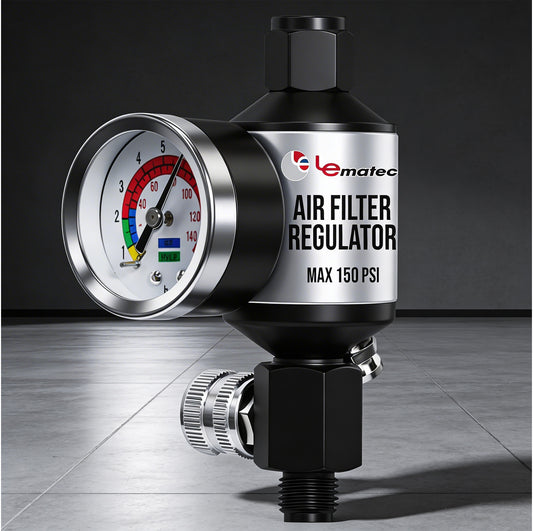
Another mistake is ignoring the regulator entirely. Running unregulated air because the compressor has enough pressure is not a good setup. Regulation gives you control and protects the tool.
A third issue is building the air system around convenience instead of flow. Small couplers, skinny hoses, and extra adapters save a few dollars up front but cost performance every time you pull the trigger.
And finally, some users blame the tool when the problem is upstream. Even a good impact wrench will feel disappointing if the air supply is undersized or restricted.
The practical answer for most users
If you want the short answer, set your impact wrench up for 90 PSI at the tool, make sure the compressor can supply the required CFM, and use a hose and fittings that do not choke airflow. For many 1/2-inch impacts, that means pairing the wrench with a 3/8-inch hose, a decent regulator, and a compressor that can keep up under repeated use.
That setup is what gets you the torque you paid for. It is also what reduces wasted time chasing weak performance that has nothing to do with the wrench itself.
For buyers who want reliable air tool performance without guesswork, Pro Air Tools focuses on the parts that matter in the real world: dependable pneumatic tools, practical accessories, and air system components that help your setup work like it should. Fast shipping and a 36-month warranty do not make a weak air system stronger, but they do make it easier to build one you can count on.
If your impact wrench is not hitting hard enough, do not just ask how much PSI it needs. Ask whether the whole air system is letting the tool do its job.
Tags:
Related articles
What Size Air Regulator Needed?
Jun 22 2026
How to Dry Compressed Air Lines Right
Jun 19 2026
Air Needle Scaler Review: What Matters
Jun 17 2026
Air Angle Grinder Disc Selection Made Simple
Jun 15 2026
Pneumatic Cutoff Tool for Sheet Metal
Jun 13 2026
Compressed Air Tool Buying Guide
Jun 11 2026
9 Best Pneumatic Tools for Garage Work
Jun 09 2026