


 AIR REGULATORS

 ACCESSORIES
Pneumatic Tool CFM & PSI Chart: Air Requirements for Every Tool Type
Pneumatic Tool CFM & PSI Requirements — The Complete Air Consumption Reference Chart
Every pneumatic tool has specific air pressure (PSI) and air volume (CFM) requirements. Run a tool with too little air and it loses power, overheats, and wears prematurely. Run it with too much pressure and you risk damaging the tool, the workpiece, or both. This reference chart gives you the exact numbers for every common air tool type, plus the rules for sizing your compressor correctly.
Written by Charles Rosenstein, Le Lematec / Factory Direct — over 15 years engineering pneumatic tools for professional and workshop use.
Understanding CFM and PSI
PSI (Pounds per Square Inch) is the pressure of the air. Think of it as the force behind each burst of air. Most air tools operate between 70–90 PSI. Higher pressure means more force but also more stress on tool internals.
CFM (Cubic Feet per Minute) is the volume of air flowing through the system. Think of it as how much air the tool consumes while running. This is the number that determines whether your compressor can keep up with your tool. There are two key CFM measurements:
- Average CFM: Air consumption during typical intermittent use (trigger on/off). Most tools aren't running continuously.
- Continuous CFM: Air consumption when the trigger is held down constantly. This is the worst-case number for tools like sandblasters, spray guns, and grinders that run for extended periods.
SCFM (Standard Cubic Feet per Minute) is CFM measured at standard conditions (68°F, 14.7 PSI atmospheric, 36% relative humidity). This is the most accurate way to compare compressors because it normalizes for altitude and temperature differences.
The Complete CFM & PSI Requirements Chart
| Tool Type | Typical PSI | Average CFM | Continuous CFM | Min. Compressor |
|---|---|---|---|---|
| Impact Wrench (3/8") | 90 PSI | 3–4 CFM | 5–6 CFM | 6 gallon, 3+ CFM |
| Impact Wrench (1/2") | 90 PSI | 4–6 CFM | 7–8 CFM | 20 gallon, 5+ CFM |
| Impact Wrench (3/4") | 90 PSI | 7–10 CFM | 12–16 CFM | 60 gallon, 10+ CFM |
| Impact Driver (1/4") | 90 PSI | 2–3 CFM | 4 CFM | 6 gallon, 3+ CFM |
| Air Ratchet (3/8") | 90 PSI | 3–4 CFM | 4–5 CFM | 6 gallon, 3+ CFM |
| Die Grinder (Straight) | 90 PSI | 4–6 CFM | 6–8 CFM | 20 gallon, 5+ CFM |
| Die Grinder (Angle) | 90 PSI | 4–6 CFM | 5–7 CFM | 20 gallon, 5+ CFM |
| Air Drill (3/8") | 90 PSI | 3–5 CFM | 4–6 CFM | 20 gallon, 4+ CFM |
| Air Hammer / Chisel | 90 PSI | 3–5 CFM | 4–6 CFM | 20 gallon, 4+ CFM |
| Needle Scaler | 90 PSI | 4–6 CFM | 6–8 CFM | 20 gallon, 5+ CFM |
| Orbital Sander | 90 PSI | 6–9 CFM | 8–12 CFM | 30 gallon, 7+ CFM |
| Belt Sander | 90 PSI | 8–12 CFM | 10–14 CFM | 60 gallon, 10+ CFM |
| Blow Gun | 30–90 PSI | 2–4 CFM | 3–6 CFM | Any compressor |
| Tire Inflator | 30–50 PSI | 1–2 CFM | 2–3 CFM | Any compressor |
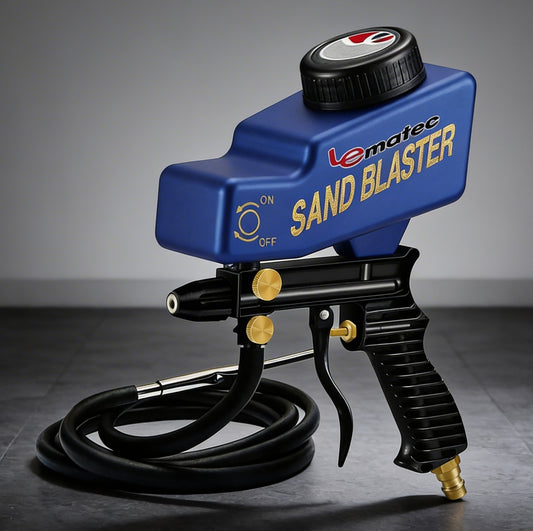
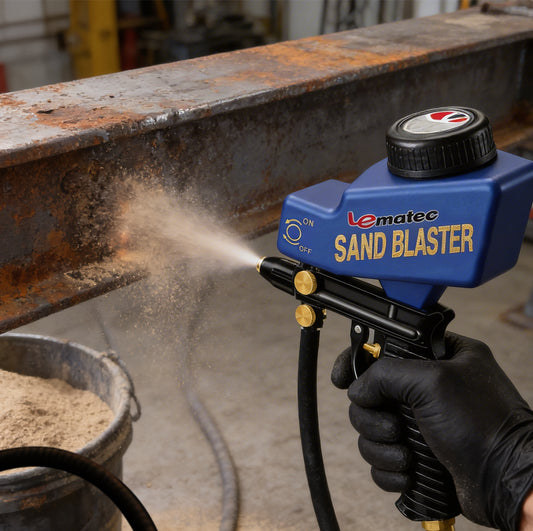
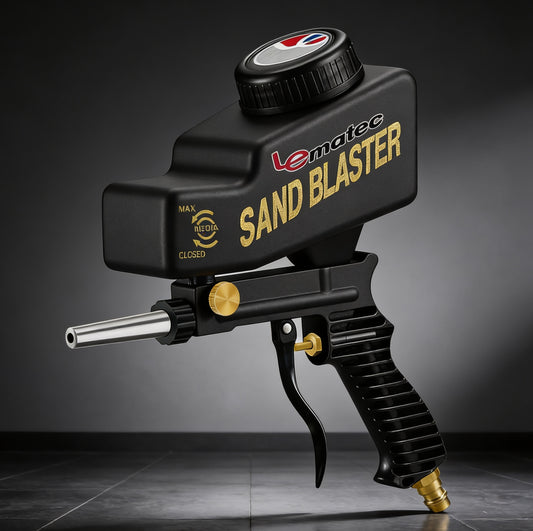
| Sandblaster (Gravity Feed) | 40–90 PSI | 4–8 CFM | 6–10 CFM | 20 gallon, 5+ CFM |
| Sandblaster (Siphon Feed) | 60–100 PSI | 6–12 CFM | 8–14 CFM | 30 gallon, 8+ CFM |
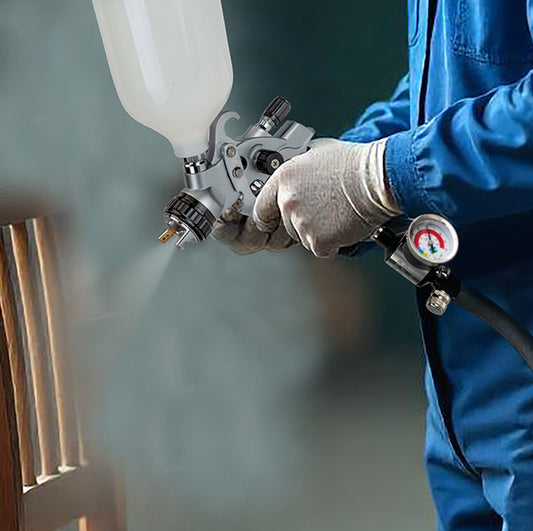
| HVLP Spray Gun | 25–50 PSI | 8–12 CFM | 10–15 CFM | 60 gallon, 10+ CFM |
| Conventional Spray Gun | 40–60 PSI | 6–10 CFM | 8–12 CFM | 30 gallon, 7+ CFM |
| Air Nibbler | 90 PSI | 3–4 CFM | 4–5 CFM | 6 gallon, 3+ CFM |
| Air Shears | 90 PSI | 4–6 CFM | 5–8 CFM | 20 gallon, 5+ CFM |
| Vacuum/Blower | 90 PSI | 4–6 CFM | 5–8 CFM | 20 gallon, 5+ CFM |
Got your CFM and PSI targets? Here's how to hit them.
Dial in the exact pressure every tool on this chart needs with the DAR01B Digital Air Regulator.
Shop the DAR01B Digital Regulator →The 1.5x Rule for Compressor Sizing
The most important rule in compressor sizing: your compressor should deliver at least 1.5 times the CFM of your most demanding tool, measured at 90 PSI.
Why 1.5x? Because compressor CFM ratings are theoretical maximums. Real-world output drops as the tank pressure cycles, hoses create friction losses, and fittings introduce restrictions. The 1.5x buffer ensures your tool always has enough air.
Example: Your 1,000 ft-lbs impact wrench needs 7 CFM continuous. Your compressor should deliver at least 10.5 CFM at 90 PSI.
Ready to put this into practice?
Digital Air Pressure Regulator (DAR01B)
Set the exact PSI for every tool in this chart. LCD display, ±1 PSI accuracy, multi-unit.
Get the Digital Air Regulator →How to Read Your Compressor's CFM Rating
Compressor manufacturers often advertise CFM at different pressures. A compressor rated at "12 CFM at 40 PSI" might only deliver 8 CFM at 90 PSI — the pressure most tools actually need. Always check the CFM rating at 90 PSI (or the closest number to it on the spec sheet). That's the real number that matters for tool compatibility.
Also watch for "displacement CFM" vs "delivered CFM." Displacement is theoretical — it's the volume the piston moves. Delivered (or free air delivery) is what actually comes out of the tank. Delivered CFM is typically 20–30% lower than displacement CFM.
Running Multiple Tools Simultaneously
If you run two or more tools at the same time, add their CFM requirements together and apply the 1.5x rule to the total:
- Impact wrench (5 CFM) + blow gun (3 CFM) = 8 CFM → need 12 CFM compressor
- Die grinder (6 CFM) + vacuum (5 CFM) = 11 CFM → need 16.5 CFM compressor
- Sandblaster (10 CFM) running solo → need 15 CFM compressor
For multi-tool shops, consider a two-stage compressor with a 60+ gallon tank. The larger tank acts as an air reserve that smooths out pressure drops when multiple tools draw air simultaneously.
Le Lematec Tool CFM Specifications
Here are the specific air requirements for our most popular tools:
- LE LEMATEC Impact Wrench (1,000 ft-lbs): 90 PSI, 7 CFM average — needs a 20+ gallon compressor
- LE-ID413 Impact Driver: 90 PSI, 3 CFM average — works with most compressors
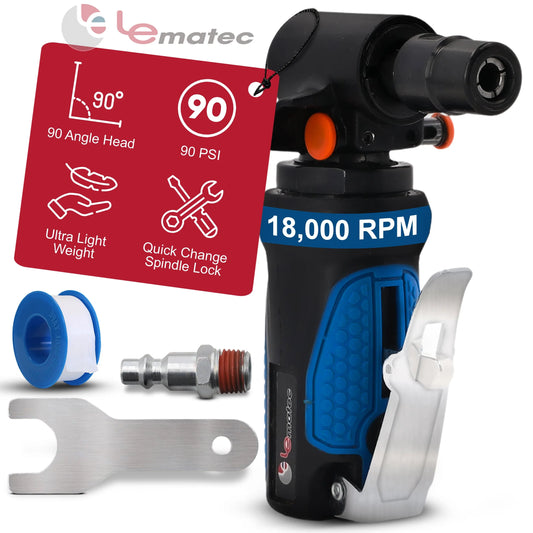
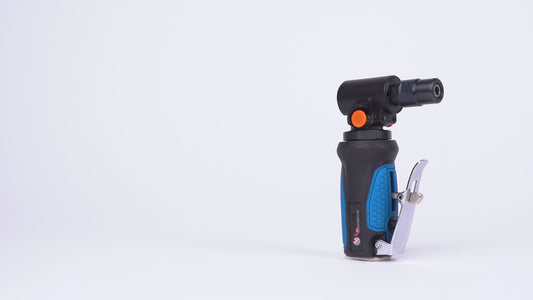
- LE-G1343L Angle Die Grinder (18,000 RPM): 90 PSI, 5 CFM average — 20+ gallon compressor recommended
- LE-G2543R Flexible Die Grinder (20,000 RPM): 90 PSI, 4 CFM average — works with most 20+ gallon compressors
- Air Needle Scaler (4,500 BPM): 90 PSI, 5 CFM average — 20+ gallon compressor
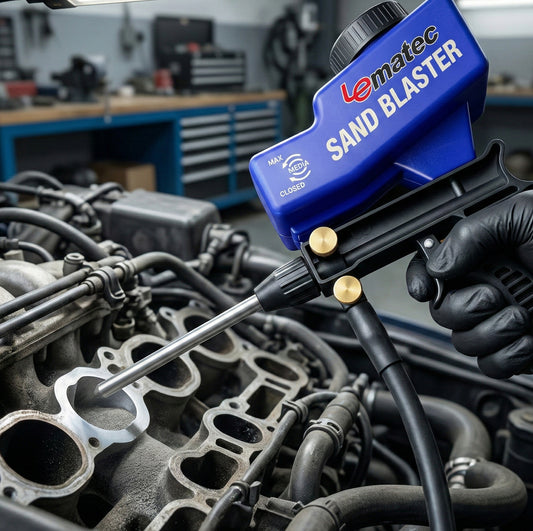
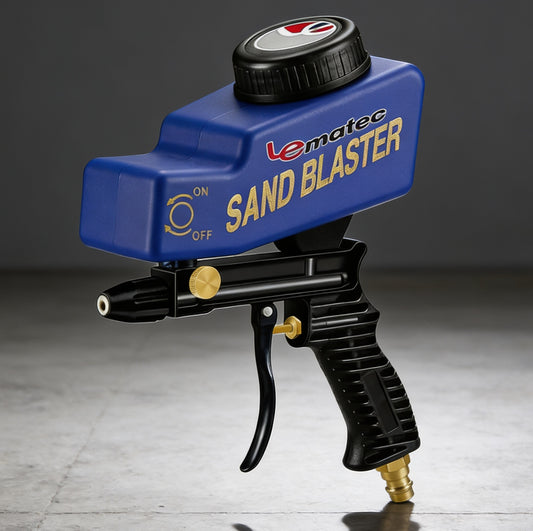
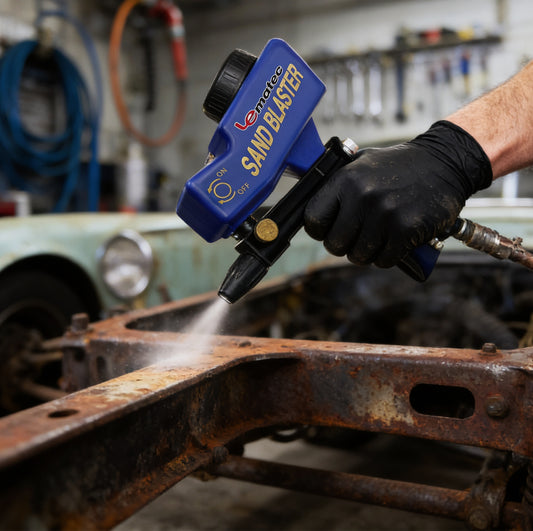
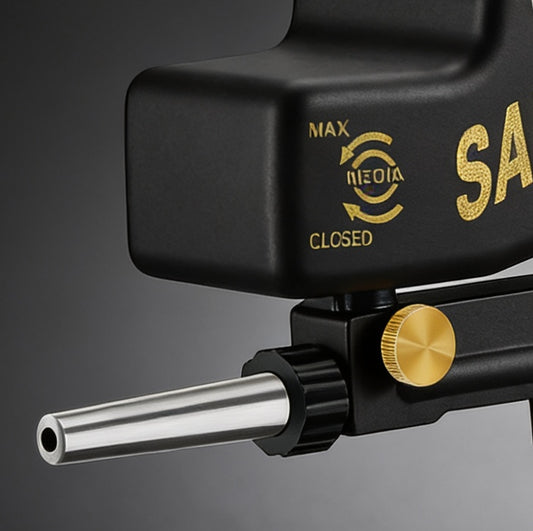
- AS118-2 Sandblaster: 40–90 PSI, 6–10 CFM — 20+ gallon for gravity feed, 30+ gallon for siphon
- Vacuum/Blower Kit: 90 PSI, 5 CFM average — 20+ gallon compressor
Maximizing Air Delivery
Even with the right compressor, poor air system setup wastes CFM. These fixes cost little and deliver immediate improvement:
- Use 3/8" hose (minimum) for runs over 25 feet. A 1/4" hose over 50 feet can drop 10+ PSI. Larger hose = less restriction = more CFM at the tool.
- Minimize fittings and connections. Every coupler, tee, and elbow creates a small pressure drop. Use the fewest connections possible between compressor and tool.
- Fix leaks. A single 1/16" leak at 100 PSI wastes approximately 3.8 CFM — enough to starve a die grinder.
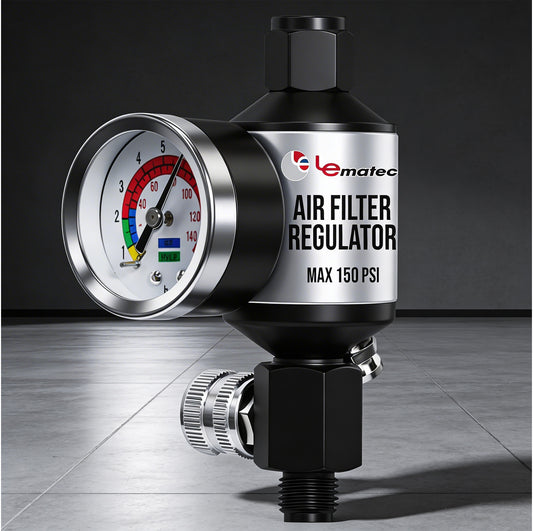
- Install a regulator at point of use. An AR-01 Regulator at the tool station ensures consistent pressure regardless of line conditions.
- Keep the compressor filter clean. A clogged intake filter reduces compressor output by 10–25%.
For complete air system setup recommendations, see our Air Compressor Accessories Buying Guide.
For help choosing the right connections for your setup, see our fittings and hose sizing guide.
Shop Professional Air Tools
Factory direct from Le Lematec — professional quality, competitive prices.
Related: Learn how to get the cleanest, most consistent air supply for your tools with our FRL (Filter-Regulator-Lubricator) setup guide.
Shop Related Products
All products ship free to the US with same-day processing.
Tags:
Previous
The Complete Guide to Filter, Regulator & Lubricator (FRL) Units
Next
Pneumatic Tool Maintenance Guide: Extend Tool Life & Prevent Costly Damage
Related articles
High Torque Impact Wrench: How Much Is Enough?
Jun 03 2026
Choosing Air Hose for Shop Layout
Jun 01 2026
How to Set Air Regulator Pressure Right
May 30 2026
Air Filter Water Separator Installation Tips
May 28 2026
Guide to Shop Air Line Layout That Works
May 26 2026
Air Ratchet vs Electric Ratchet
May 24 2026