Shopping Cart
(0)
Free shipping included — no minimum on any US order

Quick Search:


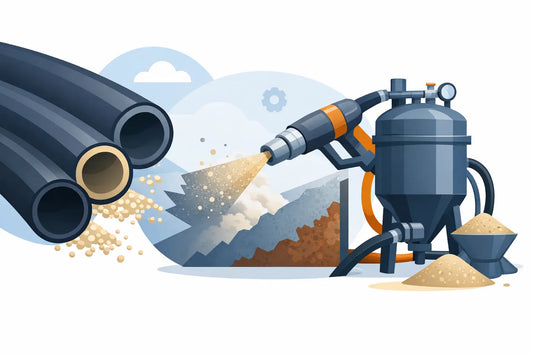
A blasting setup can look fine on paper and still perform poorly once you pull the trigger. A common reason is hose size. If you are figuring out how to choose blast hose size, the wrong inside diameter can choke airflow, slow media delivery, waste compressor capacity, and make the whole job feel harder than it should.
Blast hose size is not just a fitment detail. It changes how much air reaches the nozzle, how steadily media moves, and how responsive the setup feels in your hands. Too small, and pressure drops fast. Too large, and you add weight and bulk that may not help your setup at all. The right size is the one that matches your nozzle, air supply, hose length, and the kind of work you actually do.
The simplest way to think about blast hose sizing is this: the hose has to support the nozzle. Your nozzle determines air demand, and your compressor has to keep up with that demand. The hose sits in the middle. If it is undersized, it becomes a restriction even if the compressor and pot are otherwise capable.
Most users are choosing between 1/2-inch, 3/4-inch, and 1-inch inside diameter blast hose. For lighter-duty work and smaller nozzles, 1/2-inch hose can be enough. For many general-purpose blasting setups, 3/4-inch is the safer middle ground. For larger nozzles, longer hose runs, or production work where volume matters, 1-inch hose may be the better call.
A practical rule used across blasting setups is that the blast hose inside diameter should usually be about 3 to 4 times the nozzle orifice size. That ratio helps maintain smooth media flow and limits excessive pressure loss. So if you are running a small nozzle, a smaller hose may work well. As the nozzle gets larger, hose diameter needs to increase with it.
If you skip nozzle size and choose hose based only on what is in stock or what seems easier to handle, you are working backward. The nozzle is the main driver because it controls how much air the system consumes.
For example, a smaller nozzle used for spot work, detail cleaning, or lighter cabinet-style blasting may pair well with a 1/2-inch blast hose. Once you move into more aggressive surface prep, rust removal, or wider coverage using larger nozzles, 3/4-inch hose becomes more common. If you are running a big nozzle for faster production or heavy stripping, 1-inch hose is often the right answer.
There is always some overlap. A short setup with strong air supply might run acceptably on a smaller hose. But acceptable is not the same as efficient. If the goal is steady performance and fewer bottlenecks, sizing the hose generously for the nozzle is usually the better move.
As a general guideline, 1/2-inch hose is often used with smaller nozzles around 1/8 inch. A 3/4-inch hose is commonly matched with nozzles in the 3/16-inch range. A 1-inch hose makes more sense once nozzle size gets into larger production territory. These are not hard limits, but they are solid starting points for choosing a hose that will not hold the rest of the system back.
Length matters more than many buyers expect. The longer the hose, the more friction loss you create. That means a hose that works fine at 10 feet may become a problem at 50 feet.
If your blasting pot stays close to the work, you can often stay with a smaller hose size as long as the nozzle and compressor are also matched properly. If you need a long run across a shop floor, around equipment, or out into the field, going up one hose size can protect performance. This is one of the most common it-depends situations in blasting.
There is a trade-off. Bigger hose helps preserve flow over distance, but it also gets heavier and less flexible. For a user doing overhead work, vehicle panels, or tighter maneuvering, that extra weight matters. The best setup is not always the biggest hose. It is the hose that gives you enough flow without making the job physically harder.
A larger hose will not create more blasting power if the compressor cannot supply the air. That is where some setups get mismatched. The buyer installs a larger nozzle and larger hose expecting faster work, but the compressor falls behind and pressure drops anyway.
Before settling on hose size, check the compressor's delivered CFM at your working PSI, not just the headline number. Then compare that to the nozzle's air demand. If the nozzle already pushes the compressor near its limit, upsizing the hose may reduce restriction, but it will not fix a system that is short on air supply.
This is why hose sizing should always be part of the full system picture. Compressor, pot, metering valve, nozzle, and hose all affect results. The hose is one part of the chain, but it is a part that can quietly reduce performance if it is too small.
Airflow is only half the story. The hose also needs to move abrasive consistently. When hose size is too tight for the nozzle and media volume, flow can feel uneven. You may notice surging, poor cutting speed, or a pattern that does not stay consistent across the surface.
That matters whether you are stripping steel, cleaning cast parts, or doing automotive prep. Inconsistent media delivery makes it harder to get a uniform finish. It can also increase operator fatigue because you spend more time correcting for weak spots in the blast pattern.
With the right hose size, media moves more smoothly and the nozzle feels more predictable. That gives you better control and usually a better finish, especially on jobs where consistency matters as much as raw speed.
For many buyers, the real question is which standard size makes the most sense.
A 1/2-inch blast hose works best for smaller nozzles, lighter-duty blasting, and shorter runs where maneuverability matters. It is easier to handle and can be a good fit for smaller shops or occasional use. The downside is that it becomes a restriction sooner as nozzle size or hose length increases.
A 3/4-inch blast hose is often the best all-around choice for general blasting. It supports more airflow, handles a broader range of nozzle sizes, and gives you more room to grow without jumping straight to the bulk of 1-inch hose. For many automotive, fabrication, and maintenance users, this is the sweet spot.
A 1-inch blast hose is typically the production option. It is built for higher volume, larger nozzles, and longer distances where preserving flow matters most. It is not as easy to drag around all day, so it makes the most sense when the extra capacity is actually needed.
You can choose the correct hose diameter and still lose performance if fittings are undersized. Couplings, nozzle holders, and connection points should match the flow requirements of the hose. A narrow fitting in the line acts like a choke point.
This is especially relevant when upgrading an older setup one piece at a time. A larger hose connected through smaller hardware will not deliver the full benefit. When you size the hose up, check the rest of the flow path too.
If you want a simple buying approach, start with your nozzle size and compressor output. Then factor in hose length and how mobile you need to be during the job. If you are near the edge between two hose sizes, the safer performance choice is usually the larger one, while the better handling choice is the smaller one.
That is the real trade-off. Bigger hose supports flow and future upgrades. Smaller hose is easier to manage. For occasional blasting or compact setups, lighter handling may win. For steady shop use where time and finish quality matter, extra flow usually pays for itself.
For buyers who want a setup that works hard without trial and error, this is the point of learning how to choose blast hose size. You are not just picking a hose. You are removing one of the most common restrictions in the blasting system so the equipment can perform the way it should.
If your current setup feels weak, inconsistent, or slower than expected, hose size is worth a hard look. Getting that one decision right can make blasting easier, faster, and a lot less frustrating on the next job.


 AIR REGULATORS

 ACCESSORIES